Posts

Showing posts with the label Cleopatra VII

Greco-Roman female portraiture

Image
Head of a woman, Greek, 200-100 BCE Marble at the Yale University Art Gallery. "In Greek and Roman female portraits, private women often imitated goddesses or queens in order to gain status and influence. This head, perhaps, echoes features of the goddess Aphrodite or the Egyptian ruler Cleopatra VII (reigned 69–30 BCE).  Although extensive damage and repairs, including a damaged nose and a missing section of hair, have made examinations of the head difficult, one can still see the resemblance to the two iconic figures." "The figure’s melon hairstyle and the beginnings of what was probably a slightly aquiline nose relate the head to portraits of Cleopatra VII who is shown with these features in her more ‘masculinized’ portraits, as in her portrait on a silver denarius in the British Museum.  At the same time, the portrait of a woman also has the classic turn of the head and soft facial features one finds in portraits of typical Greek women and of Aphrodite.  Cleopatra VI...
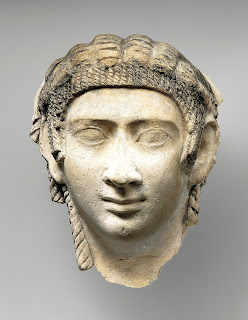
Mummy mask of a woman with corkscrew locks and bang, 50–150 CE, Roman Period Egypt

Image
Plaster Romano-Egyptian mummy masks of the 1st - 2nd century CE appear to be individualized, much like the famous mummy portraits of the Faiyum region. But, in fact, most were made in a mold.  Distinguishing details were added while the plaster was still moist with a spatula or knife. Ears were added separately and, sometimes, eyes were inlaid then the mask painted or gilded. "This woman's waved hairstyle is based on Roman court fashion, but three hanging corkscrew curls behind the ears and a short fringe of curls over the forehead and in front of the ears seem to reflect a local style. Toward the back of her head, above her ears, are traces of a smooth area that once represented a pillow. In general earlier Roman-period masks such as this one show the deceased as if reclining on a bier with the head on a pillow, while later masks have the head raised as if the deceased is rising from the bier. The underneath edge of this example is flat where it is meant to be attached to a b...

The "real" Cleopatra

Image
 The "real" Cleopatra? Cleopatra is barely mentioned in De Bello Alexandrino, the memoirs of an unknown staff officer who served under Caesar. The writings of Cicero, who knew her personally, provide an unflattering portrait of Cleopatra although it actually sounds more like Cicero did not feel he was greeted by her as one of the most important senators of Rome.  I found this imagined letter between Cicero and J.W. Worthy, late professor of philosophy at John Tarleton Military Academy, based on Cicero's writings, interesting: "I do not wish to be unfair to the graecula.  She is clever beyond words, no denying it.  You may understand my impatience with her if I remind you that, although she chatters on in Hebrew, Aramaic, Syriac, Greek of course, Parthian, Median, Egyptian (she is said to be the first Ptolemy to master that), Ethiopian, and Trogodyte, all with marvelous fluency so they say, she was unable to receive me in Latin!  Or claimed to be unable to do so,...

Queens of Egypt. Through September 2, 2019 at the National Geographic Museum in Washington D.C.

Image
Queens of Egypt.  Through September 2, 2019 at the National Geographic Museum in Washington D.C.  This exhibit focuses on seven Egyptian queens from the New Kingdom period, beginning with Ahmose-Nefertari (who reigned from 1539 to 1514 B.C.) and culminating with Cleopatra (technically known as Cleopatra VII).  It includes historical objects on loan from five European and Canadian museums, with most on loan from Museo Egizio in Turin, Italy.  These objects include a pair of Nefertari's sandals as well as a model of her lavishly decorated two-level catacomb augmented with a virtual presentation that can be viewed with virtual-reality glasses. The exhibit also presents a rare portrait bust of Cleopatra VII from Museo Egizio that has never been displayed in the U.S.  Visitors are even invited to smell some of the heady perfumes used by these queens, particularly Cleopatra who actually wrote a treatise about perfume production and formulas she developed herself. ...