Posts

Showing posts with the label Chinese

Changes in historical perceptions of Qin Shi Huangdi, first emperor of unified China
Image
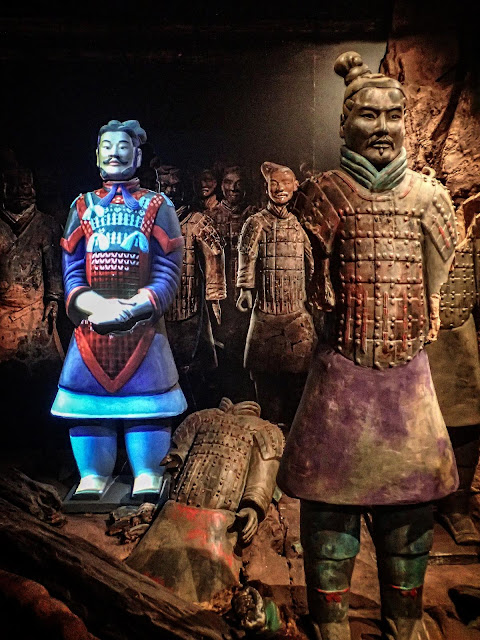
My husband and I have been watching the "Qin Empire Epic", a Chinese produced series, on Amazon Prime.  Although I can't always keep up with the subtitles (I can't read that fast from across the room!) I have found the history of the unification of China under Qin Shi Huangdi, initially called Yíng Zhèng, very interesting. Most references to China's first emperor that I had read, mostly information accompanying the three different Terracotta Warriors exhibits I have attended, seemed to emphasize the emperor's brutality, as portrayed in traditional Chinese historiography.  But, I discovered, like Roman propaganda vilifying the emperor Nero, perceptions of Yíng Zhèng's actions need to be considered in the political context of the fierce competition between warlords that dominated the tumultuous Warring States Period. Although I haven't seen any reference to burying Confucian scholars alive yet (we're on episode 78), I was researching some of the port...

The evolution of Scythian art

Image
 Early Scythian art was characterized by its use of animal motifs and appeared in eastern Europe in the 8th century BCE. Some scholars suggest the art style developed under Near Eastern influence during the military campaigns of the 7th century BCE, but the more common theory is that it developed on the eastern part of the Eurasian Steppe under Chinese influence. Others have sought to reconcile the two theories, suggesting that the animal style of the west and eastern parts of the steppe developed independently of each other, under Near Eastern and Chinese influences respectively. Regardless, the animal style art of the Scythians was distinctive and differed considerably from the cultures around it. Scythian animal style works are typically divided into birds, ungulates and beasts of prey. This probably reflects the tripartite division of the Scythian cosmos, with birds belonging to the upper level, ungulates to the middle level and beasts of prey in the lower level. Images of myth...

East Meets West: Rome and the Han Dynasty of China

Image
Ancient Rome and the Han Dynasty of China exchanged goods, not only over the famous Silk Road but by sea as well. Unfortunately, intermediate empires such as the Parthians and Kushans, seeking to maintain lucrative control over the silk trade, initially inhibited direct contact between Rome and China. Although ancient Chinese geographers demonstrated a general knowledg e of West Asia and Rome's eastern provinces, Roman histories of the 1st century BCE offer only vague accounts of China and the silk-producing Seres people of the Far East. In classical sources, the problem of identifying references to ancient China is exacerbated by the interpretation of the Latin term Seres, whose meaning fluctuated and could refer to several Asian peoples in a wide arc from India over Central Asia to China. But, by the 1st-century CE, geographer Pomponius Mela asserted that the lands of the Seres formed the centre of the coast of an eastern ocean, flanked to the south by India and to the ...

"Into China" at the Blackhawk Museum, a Smithsonian affiliate, in Danville, California

Image
"Into China" at the Blackhawk Museum, a Smithsonian affiliate, in Danville, California. Officially opened on January 25, 2020, the exhibit features a large gallery populated with replicas of famous Chinese artwork including the First Emperor of China's Terracotta Warriors and Chariots, a complete set of bells from the tomb of Marquis Yi, originally dated to 433 BCE, a 24-foot-long red Imperial Dragon statue, a scale model of the  Forbidden City, an Imperial Dragon Throne, and other carved statues, paintings, and ceramics. The museum's galleries also feature the art of Africa, Old West memorabilia, and the museum's notable classic automobile collection. Images: Bells from the tomb of the Marquis of Yi, 433 BCE, courtesy of Chinese Wikipedia contributor Zzjgbc. These bells were produced during the interregnum between the Spring and Autumn Period and Warring States Period of ancient China.