Posts

Showing posts with the label China

Changes in historical perceptions of Qin Shi Huangdi, first emperor of unified China
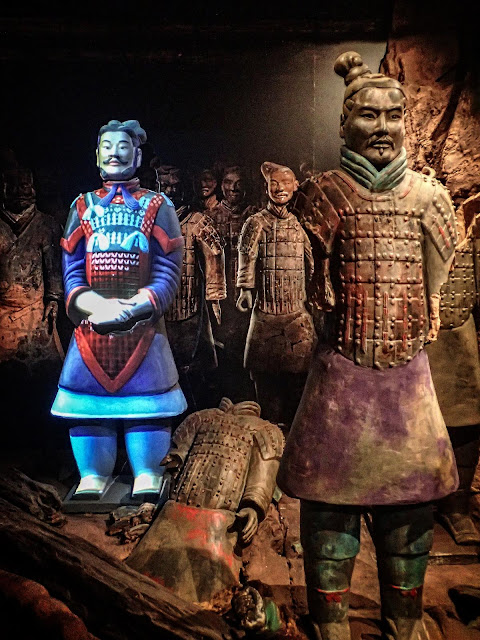
Image
My husband and I have been watching the "Qin Empire Epic", a Chinese produced series, on Amazon Prime.  Although I can't always keep up with the subtitles (I can't read that fast from across the room!) I have found the history of the unification of China under Qin Shi Huangdi, initially called Yíng Zhèng, very interesting. Most references to China's first emperor that I had read, mostly information accompanying the three different Terracotta Warriors exhibits I have attended, seemed to emphasize the emperor's brutality, as portrayed in traditional Chinese historiography.  But, I discovered, like Roman propaganda vilifying the emperor Nero, perceptions of Yíng Zhèng's actions need to be considered in the political context of the fierce competition between warlords that dominated the tumultuous Warring States Period. Although I haven't seen any reference to burying Confucian scholars alive yet (we're on episode 78), I was researching some of the port...

Chinese and Japanese art at the Penn Museum in Philadelphia

Image
Yesterday I finished editing and uploading my images of the University of Pennsylvania Museum of Archaeology and Anthropology (Penn Museum)'s Chinese and Japanese Art on display in their Asian galleries to Wikimedia Commons.  These are high resolution images suitable for both print and digital applications and I only require attribution for their use. The Penn Museum's Asian collection ranges from bronze vessels of the Zhou Period (1046-256 BCE) to sculptures of the Qing Dynasty (1644 to 1912 CE).  Most objects on display at the time of my visit in 2015 are related to Buddhism in some form. https://commons.wikimedia.org/wiki/Category:Asian_art_in_the_University_of_Pennsylvania_Museum_of_Archaeology_and_Anthropology I'm now working on my images of their ancient Egyptian collection and will begin uploading those soon.  Most of my images of their spectacular objects from ancient Mesopotamia including the death pit of Ur have been uploaded from my Flickr account by another Wi...

Penn Museum to reopen July 28, 2020!

Image
Today's featured "Antiquities Alive" exhibit:  The Penn Museum (University of Pennsylvania Museum of Archaeology and Anthropology) will reopen to the public on July 28, 2020!  Here's a selection of images I have taken of their marvelous collections! Dionysos with lion garden statuary from Latium region of Italy Roman marble Etruscan Sarcophagus 3rd century BCE Mosaic thought to depict Theseus sailing away from the Cretan labyrinth, Utica, Tunisia, First half of the 3rd century CE Roman Theater Mask of a River God from a bath complex in Teano (southern Italy) Flavian Period limestone Recarved image of Ramesses II excavated at Harsaphes, Heracleopolis, Egypt 1897-1843 BCE Gilded Cartonnage Funerary Mask Ptolemaic or Roman Period ancient Egypt Plaster funerary portrait bust of a man from El Kharga (upper) Egypt Roman Period 2nd century CE Painted Pottery Horses Tang Dynasty China 7th to 10th century BCE Guanyin Jin Dynasty (1115-1234 CE or Yuan Dynasty (1271-1368 CE) Chi...

Terracotta Warriors of the Han Dynasty

Image
Most people are familiar with the life-sized terracotta warriors from the Qin Emperor but many people are unaware there are terracotta armies from Han dynasty tombs as well, although they are about a foot tall instead of life-sized.  The first Han era-army was discovered in 1984 and it is displayed near the museum in Xuzhou.  The terracotta warriors and horses excavation site covers 6,000 square meters (1.48 acres) and includes 4,800 pieces of terracotta warriors and horses interred during the burial of Liu Wu, the third king of the Chu Kingdom during the Western Han Dynasty. The sculptures were found in 1984 in six pits, three infantry pits, one pottery-guard pit, one cavalry pit and one chariot pit. But, only two infantry pits and the pottery-guard pit have been fully excavated. The two infantry pits yielded 2,393 figures but they are smaller in size, about a foot tall, than the life-sized Xi'an terracotta warriors and horses from the Qin Dynasty. The figures were arranged ...

East Meets West: Rome and the Han Dynasty of China

Image
Ancient Rome and the Han Dynasty of China exchanged goods, not only over the famous Silk Road but by sea as well. Unfortunately, intermediate empires such as the Parthians and Kushans, seeking to maintain lucrative control over the silk trade, initially inhibited direct contact between Rome and China. Although ancient Chinese geographers demonstrated a general knowledg e of West Asia and Rome's eastern provinces, Roman histories of the 1st century BCE offer only vague accounts of China and the silk-producing Seres people of the Far East. In classical sources, the problem of identifying references to ancient China is exacerbated by the interpretation of the Latin term Seres, whose meaning fluctuated and could refer to several Asian peoples in a wide arc from India over Central Asia to China. But, by the 1st-century CE, geographer Pomponius Mela asserted that the lands of the Seres formed the centre of the coast of an eastern ocean, flanked to the south by India and to the ...