Posts

Showing posts with the label Celtic

The Gundestrup Cauldron: Nuragic Influence?

Image
Mark Cartwright of the Ancient History Encyclopedia just published and excellent article on the Gundestrup Cauldron and I wish to share it with you.  But first some of my personal musings about the object. The Gundestrup Cauldron, dated to the 1st century BCE, was discovered by workers cutting peat blocks in a bog near Gundestrup, North Jutland, Denmark on 28 May 1891 CE. The details of the decorative reliefs on the cauldron show a clear Celtic influence but some motifs, particularly the exotic animals (lions or leopards, elephants, and griffins), suggest, too, a Near Eastern influence so that scholars generally attribute its manufacture to peoples living in the Lower Danube region, specifically Dacia or Thrace (which is today’s Romania and Bulgaria). The use of silver is another link with the Lower Danube region as it is rare in Celtic art but not so in Thracian art.  When I first encountered Nuragic art from Sardinia, I wondered if those people may have had an influence on t...

Senhouse Roman Museum reopens

Image
 Senhouse Roman Museum is built upon the site of Alauna, a castrum or fort in Roman Britannia just north of the town of Maryport in Cumbria. It was linked by a Roman road to the Roman fort and settlement at Derventio (Papcastle) to the southeast, and thence by another road northeast to the regional hub of Luguvalium (Carlisle). The fort was established around 122 CE as a command and supply base for the coastal defences of Hadrian's Wall at its western extremity. There are substantial remains of the Roman fort, which was one of a series along the Cumbrian coast intended to prevent Hadrian's Wall being outflanked by crossing the Solway Firth.  Geo-magnetic surveys have revealed a large Roman town surrounding the fort. An archaeological dig discovered evidence of a second, earlier, larger fort next to, and partially under the present remains. The Roman fort site was owned from the 16th century by generations of the Senhouse family. The main building on the site was constructed as...

The Vermand Treasure

Image
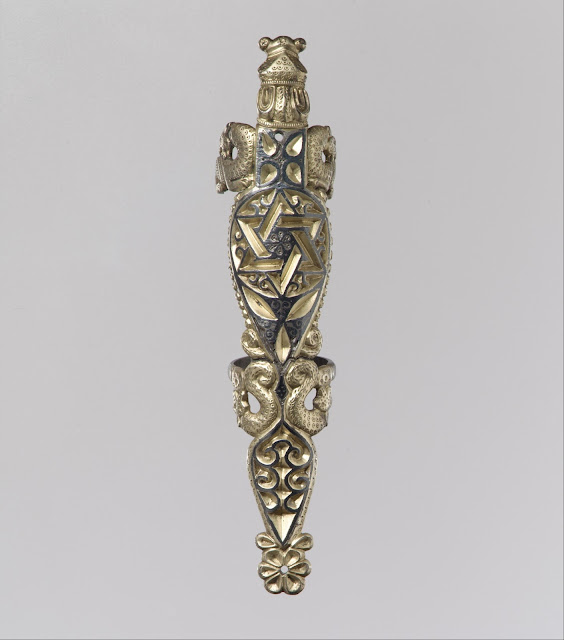
The Vermand Treasure was discovered in the last quarter of the nineteenth century by Benoni Lelaurain.  It was recovered from a cemetery near the modern village of Vermand, which is located beside the Celtic oppidum of Viromandui.  In the 3rd century CE, Vermand served as a castra hiberna within the network of provincial Roman border defenses. It was also a thriving glass production center and home to a large number of refugees following the destruction of Augusta Viromanduorum in the late 3rd century by barabarian invaders. The treasure was found in one of the few military burials in the cemetery.  However, grave robbers had previously plundered the burial, cracked the stone sarcophagus and scattered the contents. Perhaps they had been interrupted in their violation of the grave as six objects including this gilt silver spear shaft mount were left behind.  Others, documented in the excavation report, remained as well but it is thought the excavator's workmen pilf...