Posts

Showing posts with the label Carthage

Plautus and Roman comedy in times of war

Image
The comedic plays of Titus Maccius Plautus are said to be mostly adapted from the works of established Greek playwrights like Menander, referred to as Greek New Comedy. The resulting plays, thought to be around 130 works, were written between 205 and 184 BCE. Only 20 have survived to modern times.   Unlike the Old Comedy of such playwrights as Aristophances with its critical commentary on politics and societal values, New Comedy has been described as "devoid of a serious political, social or intellectual content" and "could be performed in any number of social and political settings without risk of giving offense." Instead, there is much more of a focus on the home and the family unit—something that the Romans, including Plautus, could easily understand and adopt for themselves later in history. However, Plautus did not ignore the Roman Republic's expansion of power and influence that was taking place during this time.  A. F. West observed that Plautus inserted ...
Autonomy differences between Carthaginian and Roman commanders

Image
Competition among the elites of Rome in both the political and military spheres is well known. It was also used by one of Rome's most fiercesome opponents as well.  In Carthage, command was sometimes shared between two or even three generals and sometimes commanders were expected to seek approval from the council of 104 and the two suffetes (roughly equivalent to Rome's consuls) for  important decisions such as declaring a truce, to sue for peace, or withdraw from a conflict altogether. Furthermore, punishment of command officers was draconian (in every sense of that word!). It ranged from large fines to crucifixion of the offending general.  Even the families of those committing suicide were not spared humiliation.  Ancient sources record that the council crucified the corpse of one commander named Mago (out of the many men named Mago in the history of Carthage) in 344 BCE.  Scholars think these severe punishments rather than simply a  loss of command may ...

Mysterious names of ancient ceramics

Image
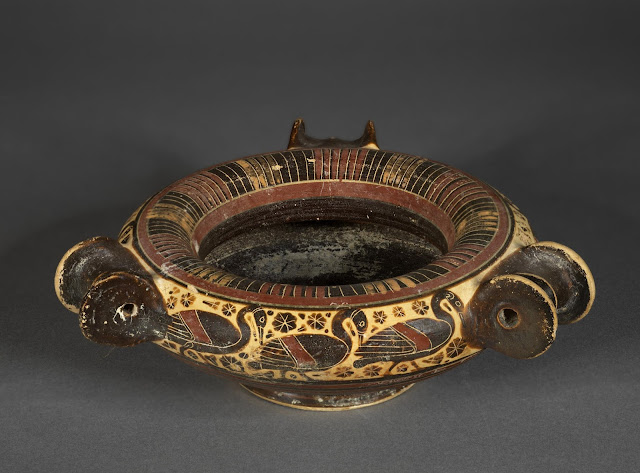
As I study ancient history I am always intrigued by the names that have been given to various ceramic vessels that have been recovered from archaeological sites.  Sometimes, the names of objects can be found in ancient sources.  Sometimes the names are given to objects by archaeologists because they resemble other fixtures that have been previously named.  In my translation of the Pompeianarum Antiquitatum Historia I have been a bit flustered by some of the names given objects by 18th and 19th century archaeologists because these names have not carried through to the 21st century or the objects have acquired a more common name since then. So, without accompanying illustrations, I have no idea what the artifacts actually look like. I've purchased texts purporting to be dictionaries of ancient ceramics but even they do not contain the terms I have found. Anyway, although I have photographed hundreds of Greek ceramics in museums around the world, this morning while searching...

Carthago: The Immortal Myth September 27, 2019 through March 29, 2020 at the Colosseum and Forum Romanum in Rome, Italy.

Image
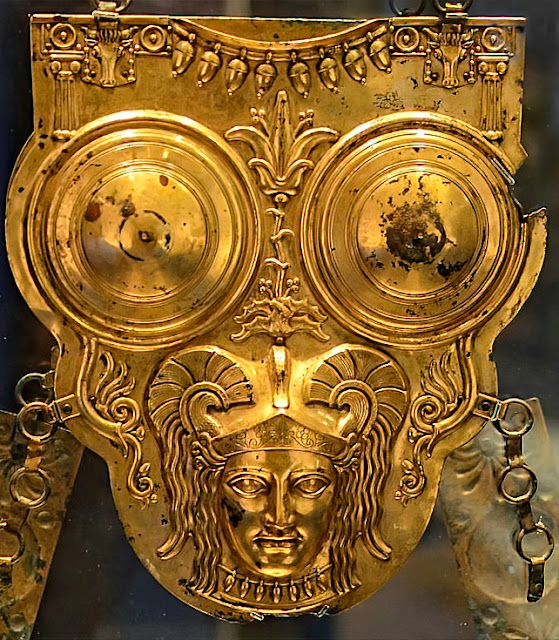
Carthago: The Immortal Myth September 27, 2019 through March 29, 2020 at the Colosseum and Forum Romanum in Rome, Italy. The history and culture of one of the most powerful and fascinating cities of the ancient Mediterranean will be celebrated in the Colosseum, the Temple of Romulus, and the Imperial Ramp at the Forum Romanum beginning September 27, 2019. The exhibition will feature reconstructions and multimedia installations  alongside artefacts displayed in public for the first time, highlighting a series of historical events uniting the two great powers of the ancient world: Carthage and Rome. Objects on display include items from the collections of archaeological museums in Italy as well as the Carthage National Museum and the Bardo in Tunisia, and the national museums of Beirut in Lebanon, and Madrid and Cartagena in Spain. Visitors will be greeted by a reconstruction of the terrible deity Moloch, featured in the 1914 film Cabiria, stationed at the entrance to the Colosse...