Posts

Showing posts with the label Byzantine

The Galloway Hoard Exhibit through September 12, 2021 at the National Museum of Scotland

Image
Discovered by a metal detectorist in Dumfries and Galloway, Scotland in 2014, the Galloway Hoard, buried around 900 CE, contains over 100 diverse objects, from silver, gold and jewelled treasures to rarely surviving textiles, including wool, linen and Scotland’s earliest examples of silk.   It is thought that the hoard was buried some time in the mid-ninth or tenth century, though it is not known why it was buried. The hoard consists of a variety of gold and silver objects including armbands, a silver pectoral cross, brooches, ingots, and what is possibly the largest silver Carolingian pot ever discovered. The pot was one of the older items in the hoard and may have been more than 100 years old by the time it was deposited. It is made of a silver alloy and was found wrapped in the remains of a cloth, with its lid still in place. It contained a collection of silver Anglo-Saxon disc brooches, an Irish silver brooch, Byzantine silk from the area around Constantinople, a gold ingo...

Silver plate possibly depicting the debate between Myth and Science

Image
Two seated philosophers, labeled Ptolemy and Hermes, engage in a spirited discussion on this fragmentary plate. A woman stands behind each man, gesturing and partaking in the exchange. The woman on the left is identified as Skepsis. Above the two seated men, an unidentified enthroned man is partially preserved. The scene on this plate has been interpreted as an allegory of the debate between Myth and Science: Ptolemy, the founder of the Alexandrian school of scientific thought, debating Hermes Trismegistos, a deity supporting the side of myth. - J. Paul Getty Museum Hermes Trismegistus, "Hermes the Thrice-Greatest" or Mercurius ter Maximus in Latin, is a legendary Hellenistic figure that originated as a syncretic combination of the Greek god of interpretive communication, Hermes, and the Egyptian god of wisdom, Thoth. He is the purported author of the Hermetica, a widely diverse series of ancient and medieval texts that lay the basis of various philosophical systems known as ...

The David Plates plus one

Image
In 628–29 CE the Byzantine emperor Herakleios (also spelled Heraclius) (r. 610–41) successfully ended a long, costly war with Persia and regained Jerusalem, Egypt, and other Byzantine territory. Silver stamps dating to 613–29/30 on the reverse of these masterpieces place their manufacture in Herakleios’s reign. The biblical figures on the plates wear the costume of the early Byzantine court, suggesting to the viewer that, like Saul and David, the Byzantine emperor was a ruler chosen by God. Elaborate dishes used for display at banquets were common in the late Roman and early Byzantine world; generally decorated with classical themes, these objects conveyed wealth, social status, and learning. This set of silver plates may be the earliest surviving example of the use of biblical scenes for such displays. Their intended arrangement may have closely followed the biblical order of the events, and their display may have conformed to the shape of a Christogram, or monogram for the name of Ch...

Byzantine warriors of the 4th - 5th centuries BCE

Image
 The Byzantine army evolved from that of the late Roman Empire, but it became considerably more sophisticated in strategy, tactics and organization over time. The language of the army was still Latin, until the 6th century when Greek became the official language of the entire empire. Unlike the Roman legions, though, the Byzantines' strength was in its cavalry, especially the armored cataphracts, which evolved from the clibanarii of the late empire.  The Romans introduced armored cavalry after clashing with cataphracts at the battles of Magnesia in 190 BCE against the Seleucids, Trigranocerta in 69 BCE against the Armenians, and the disastrous Carrhae in 53 BCE against the Parthians. Parthian cataphracts became a constant threat from the 1st - 2nd centuries CE then their threat was replaced by the cataphracts of the Sassanian Persians in the 3rd century CE. Marc Antony and Cleopatra employed contarii (from the Greek kontarioi meaning lancers) in the 1st century BCE and, when T...

Triumphal regalia

Image
 In Republican Rome, truly exceptional military achievement merited the highest possible honors, which connected the vir triumphalis ("man of triumph", later known as a triumphator) to Rome's mythical and semi-mythical past. Triumphs were tied to no particular day, season, or religious festival of the Roman calendar. Most seem to have been celebrated at the earliest practical opportunity, probably on days that were deemed auspicious for the occasion. Tradition required that, for the duration of a triumph, every temple was open. The ceremony was thus, in some sense, shared by the whole community of Roman gods, but overlaps were inevitable with specific festivals and anniversaries.  The dates selected for some triumphs may have been coincidental with other official festivals while others were maneuvered to coincide. For example, March 1, the festival and dies natalis of the war god Mars, was the traditional anniversary of the first triumph by Publius Valerius Publicola (504...

Byzantine Temple Pendants

Image
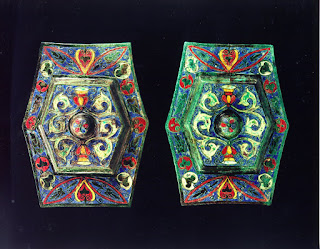
Temple pendants are thought to have hung near the temple or cheek, suspended from the wearer’s hair or headdress. The pendant’s hollow interior probably held a piece of perfumed cloth. A small stick would have been used to guide the cloth in and out of the pendant. When Kievan Rus, a powerful new state to the north of the Byzantine Empire, accepted Christianity as its official religion in 988, the aristocracy also adopted the manners and dress of the Byzantine court. Local artists soon produced their own versions of Constatinopolitan fashions. Temple pendants of precious metals worked in cloisonné enamel or niello are local variants of the more intricately detailed works made for the Byzantine court. As in Byzantium, temple pendants may have been worn next to the face by both the men and the women of Rus. The works in the Metropolitan Museum of Art were perhaps buried by their owners when the Mongol armies under Batu Khan sacked Kiev in 1240. In her paper "Temple Pendants' in ...

Heraclius: The David of the Eastern Roman Empire?

Image
The year the Roman emperor Heraclius came to power, the empire was threatened on multiple frontiers. Heraclius immediately took charge of the Byzantine–Sasanian War of 602–628. The first battles of the campaign ended in defeat for the Byzantines. The Persian army fought their way to the Bosphorus but Constantinople was protected by impenetrable walls and a strong navy, and Heraclius was able to avoid total defeat. Soon after, he initiated reforms to rebuild and strengthen the military. Heraclius drove the Persians out of Asia Minor and pushed deep into their territory, defeating them decisively in 627 at the Battle of Nineveh. The Persian king Khosrow II was overthrown and executed by his son Kavad II, who soon sued for a peace treaty, agreeing to withdraw from all occupied territory.  The Eastern Roman empire thus regained Jerusalem, Egypt, and other Byzantine territory.  To celebrate his victory Heraclius ordered the production of a set of silver plates. Elaborate dishes us...

Oil Lamps: Bringing Light to the Ancient World

Image
Oil Lamps: Bringing Light To The Ancient World: The first manufactured red pottery oil lamps appeared during the Chalcolithic Age (4500-3300 BCE. These were of the round bowl type. These evolved into wheel-made lamps during the Bronze Age (3200-1200 BCE). These lamps were essentially a shallow bowl with slight pinches on four sides for the wick and featured little or no decoration. In the Iron Age (1200-560 BCE) lamp rims became wider and flatter with a deeper and higher spout and shapes began to vary. Lamps also became more closed to avoid spilling. During the early Roman period, molds were used to produce lamps in large scale factories. The lamp was produced in two parts, the upper part with the spout and the lower part with the fuel chamber. Most were round with nozzles of different forms (volute, semi-volute, U shaped), with a closed body and with a central disk decorated with reliefs and its filling hole. However, more simple factory-made lamps, known as Firmalamp...

Thracian art at the Tekirdağ Museum of Archaeology and Ethnography in Tekirdağ, Turkey

Image
Thracian art at the Tekirdağ Museum of Archaeology and Ethnography in Tekirdağ, Turkey. During excavations in the ancient cities of Heraion-Teichos (City of Hera) in Süleymanpaşa, Çavuşköy in Malkara and Perinthos in Marmaraereğlisi, many Thracian works have been discovered including jewelry, coins, weapons, reliefs and grave goods from the tomb of a Thracian king Kersopleptes. There are also silver vessels, candlesticks and sh ields from the Macedonian era as well as archaeological finds from the Early Bronze Age (3000-2500 BCE), Late Bronze Age (2000-1200 BCE), Early Iron Age (1400-1000 BCE), and the Hellenistic Period, Artifacts from the ancient Roman, Byzantine and Ottoman eras are also on display. Image: Gladiator Relief from Perinthos (ancient Marmara) courtesy of Wikimedia Commons contributor Ollios.

Steelyard weights at the Metropolitan Museum of Art in New York City

Image
Steelyard weights at the Metropolitan Museum of Art in New York City. Steelyards of different sizes have been used to weigh loads ranging from ounces to tons. A small steelyard could be a foot or less in length and thus conveniently used as a portable device that merchants and traders could use to weigh small ounce-sized items of merchandise. In other cases a steelyard could be several feet long and used to weigh sacks of flour  and other commodities. Even larger steelyards were three stories tall and used to weigh fully laden horse-drawn carts. A simple steelyard balance with a lever mechanism first appeared in the ancient Near East over 5,000 years ago. The steelyard was in use among Greek craftsmen of the 5th and 4th centuries BCE, even before Archimedes demonstrated the law of the lever theoretically. The Latin name statera comes from the Ancient Greek stater. Roman and Chinese steelyards were independently invented around 200 BCE. Steelyards dating from 100 to 400 CE ha...

National Archaeological Museum of Tirana, Albania

Image
National Archaeological Museum of Tirana, Albania National Archaeological Museum of Tirana, Albania, opened in 1948, houses more than 2,000 items. These objects include artifacts from the Stone Age (100,000 to 2000 BCE, the Bronze Age and Iron Age from 2000 to 800 BCE, the beginnings of the Illyrian civilization from ca. 1000 BCE, the Illyrian Antiquity Period from 1000 BCE to 100 CE, the Roman and Byzantine civilization in Alban ia from 100 to 600 CE and the Albanian Middle Ages through Ottoman rule from 600 CE until Independence in 1912. Art on display includes sculpture, funerary monuments, ceramics, tools, weapons, and ancient jewelry. Image: Artemis Hekate 3rd century BCE from Apollonia courtesy of Wikimedia Commons contributor Fanny Schertzer

Roman-era mosaics in the Adana Archaeology Museum in Adana, Turkey

Image
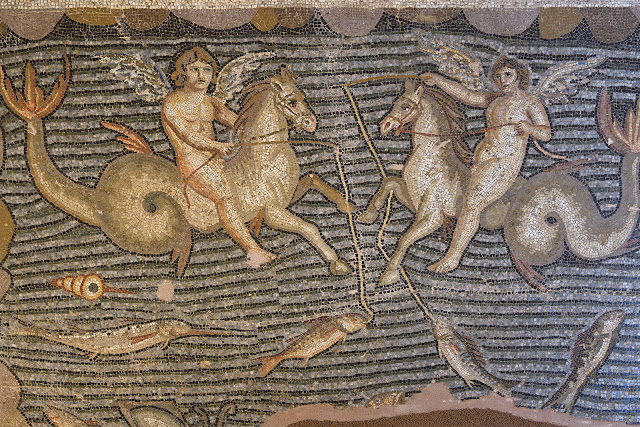
Roman-era mosaics in the Adana Archaeology Museum in Adana, Turkey.  Newly opened galleries at the Adana Museum now house an astonishing collection of Roman-era mosaics.  The mosaics depict an array of themes from classical mythology including Orpheus, Thetys, Artemis, and Erotes, as well as early Christian portrayals of the "Peaceful Kingdom" and Noah's Ark.  The museum has constructed elevated walkways in the new gallery space so visitors can view the expansive mosaics, many that once adorned church floors, more easily. The museum also has many objects from the Hittite period as well as artifacts from the Neolithic, Bronze Age, Iron Age, Archaic, Roman, Byzantine, and Ottoman eras.  Roman objects include sarcophagi, jugs, catapult shots, inscriptions, architectural elements, glassware, ceramics and jewellery. All images cc by courtesy of Dick Osseman: