Posts

Showing posts with the label British Museum

Nero: The Man Behind the Myth to open at the British Museum May 27, 2021
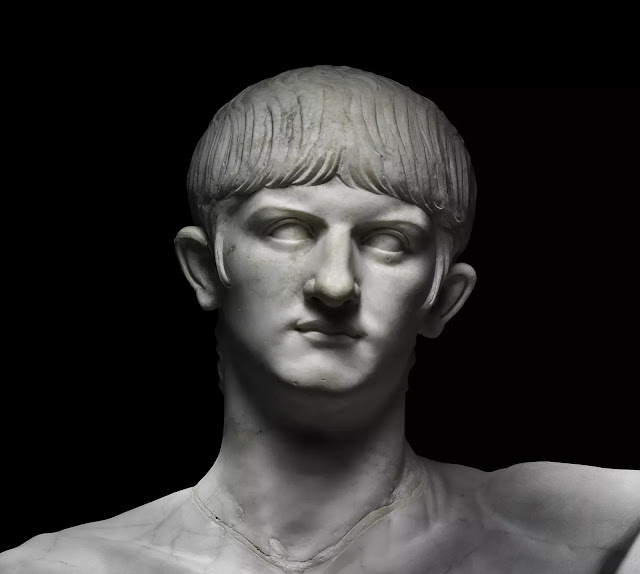
Image
An exhibition that will examine the misogynistic treatment of women under the reign of the emperor Nero is slated to open at the British Museum on May 27, 2021.  It will be on display until October 24, 2021. This "fresh look" at one of Rome's most notorious emperors will include more than 200 objects from the imperial palace in Rome to the streets of Pompeii that appear to contradict the traditional depiction of the “tyrant”, which is based on a “narrow range” of “brutally biased and partisan” sources. Part of the exhibition will also explore the role of imperial Roman women who were portrayed as adulterous and incestuous. Visitors will be able to see sculpture, manuscripts, objects destroyed in the 64 CE Great Fire of Rome, jewelry and even slave chains from Wales.  The Fenwick Hoard, a treasure discovered in 2014 beneath the floor of a shop in Colchester, will also be on display. Drawing on the latest research, this major exhibition questions the traditional narrative o...

The Duality of Aphroditus

Image
While looking through my images of artifacts in the British Museum this morning, I came across this terracotta figurine from Boeotia dated to around 400 BCE.  It is identified as merely a youth crowned with a wreath holding a puppy while another dog stands beside him.  As I studied the image, though, I wondered about the identification of it as just a youth.  The broad hips and thighs are reflective of a female form although it is clearly male.  I wondered if it may be a type of Aphroditus statue.  The deity is thought to have arrived in Athens from Cyprus in the 4th century BCE although there have been some Aphroditus herms dated to the 5th century BCE.  Aphroditus was later renamed  Hermaphroditos to reflect its parentage from Aphrodite and Hermes. The deity makes an appearance in the work, On Moral Characters, penned by Theophrastus.  A native of the island of Lesbos, Theophrastus succeeded Aristotle in the Peripatetic school. His given name wa...

The revolutionary Orientalizing Period in Mediterranean art

Image
These gold plaques depicting a winged goddess flanked by lions were created on the island of Rhodes during the so-called "orientalizing period."  This reference in art history is used to describe a development in western art beginning in the latter part of the 8th century BCE when there was a heavy influence from the art of the eastern Mediterranean including Assyria, Phoenicia, and Egypt.  During this time Greek motifs began to shift from geometric designs to the depiction of deities, animals, and mythological creatures.  Two schools of thought exist regarding the question of whether or not Geometric art itself was indebted to eastern models. In Attic pottery, the distinctive Orientalizing style known as "proto-Attic" was marked by floral and animal motifs. It was the first time discernibly Greek religious and mythological themes were represented in vase painting. The bodies of men and animals were depicted in silhouette, though their heads were drawn in outline. W...

Not all Spartans were warriors

Image
Although Sparta is renowned for its military prowess, there were Spartan poets, sculptors, magistrates, ambassadors, and governors as well as soldiers.  Originally, however, full citizen Spartiates were barred by law from trade or manufacture, which consequently rested in the hands of the Perioikoi, free peoples who did not enjoy full citizen-rights but were not subjected to the restrictions of helots.  Perioikoi served partly as a kind of military reserve, partly as skilled craftsmen and partly as agents of foreign trade - actually rather similar to the roles of freedmen in Roman society. Spartans were prohibited from possessing gold and silver coins, and according to legend Spartan currency consisted of iron bars to discourage hoarding. It was not until the 260s or 250s BCE that Sparta began to mint its own coins. Though the conspicuous display of wealth appears to have been discouraged, this did not preclude the production of very fine decorated bronze, ivory and wooden wor...

Tomb bust plaques in ancient Greece

Image
 Plaques in the form of a bust were sometimes placed in tombs of women in ancient Greece as token representations of ideal and perpetual maidenhood.  The female is sometimes depicted wearing a crown (polos) possibly alluding to tragic virgins of myth such as Persephone, the daughter of Zeus and Demeter who became the queen of the underworld through her abduction by Hades, the god of the underworld.  Persephone and her mother Demeter were the central figures of the Eleusinian Mysteries, which promised the initiated a more enjoyable prospect after death. Image: Painted Terracotta Tomb plaque made in Boeotia about 420-390 BCE that I photographed at the British Museum in 2016.

The Oxus Treasure and the challenges of provenance

Image
The Oxus Treasure is a collection of about 180 surviving pieces of metalwork in gold and silver from the Achaemenid Persian period which were found by the Oxus river about 1877-1880.  The metalwork is believed to date from the sixth to fourth centuries BCE and is thought to belong to a temple where votive offerings were deposited over a long period. Sculptural objects include two model chariots in gold, one incomplete, plus figures of a horse and a rider that may belong to this or other model groups, as may two other horses cut out from sheet gold. The wheels of the complete chariot would originally have turned freely, and it had received at least one repair in antiquity. It is pulled by four horses (rather small, and with only nine legs surviving between them) and carries two figures, a driver and a seated passenger, both wearing torcs. The chariot has handrails at the open rear to assist getting in and out, while the solid front carries the face of the protective Egyptian dwarf-...

The cornucopia in Greco-Roman mythology

Image
Bronze repoussé relief  from a hydria (water jar), fragments of which were found with the relief 325-300 BCE from Chalke, near Rhodes. Dionysos holds a cornucopia as an offering to Ariadne of prosperity and abundance while Ariadne signals her acceptance by holding back her veil. Photographed at the British Museum. Mythology offers multiple explanations of the origin of the cornucopia. One of the best-known involves the birth and nurturance of the infant Zeus, who had to be hidden from his devouring father Cronus. In a cave on Mount Ida on the island of Crete, baby Zeus was cared for and protected by a number of divine attendants, including the goat Amaltheia ("Nourishing Goddess"), who fed him with her milk. The suckling future king of the gods had unusual abilities and strength, and in playing with his nursemaid accidentally broke off one of her horns, which then had the divine power to provide unending nourishment, as the foster mother had to the god. In another myt...

Sirens in ancient mythology and beyond

Image
In Greek mythology, the Sirens were dangerous creatures who lured nearby sailors to their deaths by enchanting them with music and singing voices which resulted in their shipwreck on the rocky coast of the sirens' island. Roman poets placed them on some small islands called Sirenum scopuli. Later, their "flowery" island of Anthemoessa, or Anthemusa, was considered to be  Cape Pelorum or the Sirenuse, near Paestum.  Plato said there were three kinds of Sirens: the celestial, creatures of Zeus,  the generative of Poseidon, and the cathartic of Hades. Originally, Sirens were shown to be male or female, but the male Siren disappeared from art around the fifth century BCE.  In addition to their role in menacing seamen, sirens were also thought to accompany souls on the journey to the afterlife, hence their portrayal on funerary art.  Sirens were first believed to look like a combination of women and birds in various  forms in ancient Greek, Etruscan, and Roma...

Horse Trappings in the time of Alexander the Great

Image
The power of mobility  given by mounted units in warfare was recognized early on, but was offset by the difficulty of raising large forces and by the inability of horses (then mostly small) to carry heavy armor. Nonetheless, there are indications that, from the 15th century BCE onwards, horseback riding was practiced amongst the military elites of the great states of the ancient Near East, most notably those in Egypt, Assyria, the Hittite Empire, and Mycenaean Greece. Cavalry techniques, and the rise of true cavalry, were an innovation of equestrian nomads of the Central Asian and Iranian steppe and pastoralist tribes such as the Iranic Parthians and Sarmatians.  Initially, riders had no spurs, saddles, saddle cloths, or stirrups. Fighting from the back of a horse was much more difficult than mere riding. The cavalry acted in pairs. The reins of the mounted archer were controlled by his neighbor's hand. Even so, at this early time, cavalry used swords, shields, spears, and bo...

Bronze Herm of Herakles

Image
This type of bronze pillar herm of Herakles wrapped in a lion skin  and wearing an ivy wreath, found in the sea off the coast of Halikarnassos, was often used as a boundary marker for gymnasia and palaestrae (exercise yards).  Marble examples have been found on the island of Delos.  Similar reliefs of Herakles have also been found  in east Greece on Hellenistic graves. I photographed this herm on my last visit to the British Museum in 2016.  It is dated between 200-100 BCE. Bronze herm of Herakles Greek 200-100 BCE Halikarnassos.  Photographed at The British Museum in London.

Bes, Egyptian God in a Roman Context

Image
Bes together with his feminine counterpart Beset, is an Ancient Egyptian deity worshipped as a protector of households and, in particular, of mothers, children and childbirth. Bes may have been a Middle Kingdom import from Nubia or Somalia, and his cult did not become widespread until the beginning of the New Kingdom.  Bes was responsible for such varied tasks as killing snakes, fighting off evil spirits, watching after children, and aiding women in labour by fighting off evil spirits, and thus present with Taweret at births. Since he drove off evil, Bes also came to symbolize the good things in life – music, dance, and sexual pleasure. In the New Kingdom, tattoos of Bes could be found on the thighs of dancers, musicians and servant girls. Many instances of Bes masks and costumes from the New Kingdom and later have been uncovered. These show considerable wear, thought to be too great for occasional use at festivals, and are therefore thought to have been used by professional per...

Pottery askos in the form of a lion preparing to spring, Etruscan, 340-300 BCE at the British Museum

Image
An askos was a vessel used to dispense small quantitites of liquids such as oil. They were used most commonly for refilling oil lamps. The original meaning of askos was wineskin. This example, thought to have been made in Chiusi, Italy has a base of irregular outline that has been cut away inside so as to leave only a narrow support, has a glazed black, and is decorated with a wavy pattern. The motif of the lion drawing back and snarling was popular in the art of both Etruria and southern Italy in the second half of the 4th century BC. It is frequently found on Greek vases and is also common in Etruscan funerary sculpture, particularly in Tuscania and Vulci, and most notably on the frieze of the Tomba François itself where this askos was probably found. All the examples pre-suppose an opponent: one is rarely shown. Buranelli suggests that the opponent may originally have been Herakles, and that the lion is the Nemean lion, shown at the moment before the hero seizes it. In support of ...

Tanagra Figurines: From Elegant to Whimsical

Image
Tanagra Figurines: From Elegant to Whimsical. Tanagra figurines are mold-cast Greek terracotta figurines produced from the later fourth century BCE up to the 1st century BCE, primarily in the Boeotian town of Tanagra, which has given its name to the whole class but also in Alexandria, Tarentum in Magna Graecia, Centuripe in Sicily and Myrina in Mysia. The vast majority of the figures depict women in everyday apparel with accees sories like hats, wreaths, or fans. But men and boys, Eros, Aphrodite, and grotesques were also subjects. Some character pieces may have represented stock figures from the New Comedy of Menander and other writers. Others continued an earlier tradition of molded terracotta figures used as cult images or votive objects. Researchers think some Tanagra figurines were religious in purpose, but most seem to have been entirely decorative. However, those placed in tombs as grave goods are not thought to have served the deceased in the afterlife in any way unlike fig...