Posts

Showing posts with the label Aztec

Spotted cats: Mythological beasts of both the Old World and the New
Image
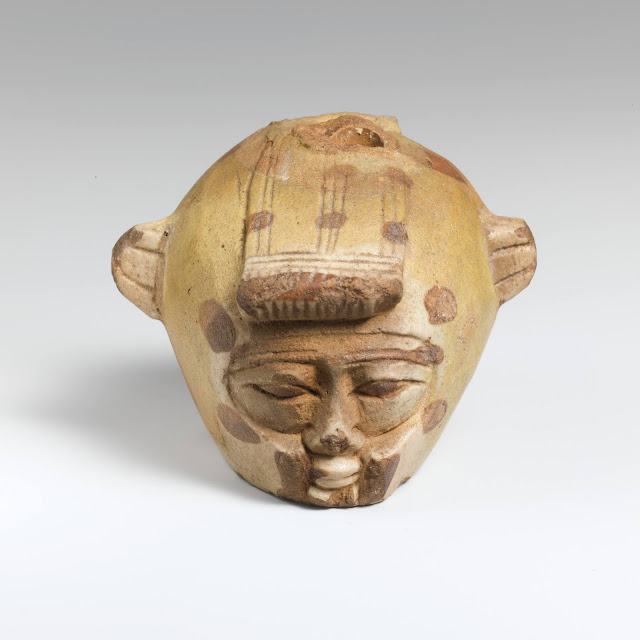
This unusual vase shows a human head of which all but the area of the eyes, nose, and mouth is enclosed in the head of an animal. The softness of the pelt is indicated by the way in which it tightly fits the human head. The small ears and spots are further animal attributes. It is difficult to identify the figure. It may possibly be a very Egyptianized interpretation of Herakles wearing the lion skin. - Metropolitan Museum of Art This vessel caught my attention because it reminded me very much of ancient pre-Columbian American art.  All major Mesoamerican civilizations prominently featured a jaguar god, and for many, such as the Olmec, the jaguar was an important part of shamanism. The jaguar's formidable size, reputation as a predator, and its evolved capacities to survive in the jungle made it an animal to be revered. The Olmec and the Maya witnessed this animal's habits, adopting the jaguar as an authoritative and martial symbol, and incorporated the animal into their mythol...

Ancient Art of Mesoamerica

Image
Mesoamerica gave rise to a group of stratified, culturally related agrarian civilizations spanning an approximately 3,000-year period before European arrival.  This assortment of ancient cultures that shared religious beliefs, art, architecture, and technology included the Olmec, Teotihuacan, Maya, Zapotec, Mixtec, Huastec, Purepecha (also known as the Tarascans), Toltec, and Mexica/Aztecs.  These indigenous civilizations built pyramid-temples, and developed mathematics,  astronomy, medicine, a unique writing system, highly accurate calendars, fine arts, intensive agriculture, engineering, an abacus calculator, and complex theology.  Their number system was base 20 and included zero.  While many city-states, kingdoms, and empires competed with one another for power and prestige, they consolidated power and distributed influence in matters of trade, art, politics, technology, and theology.  Evidence of trade routes starting as far north as the Mexico Central...

Museum of History of the Yucatan and Mayan culture in the Palacio Canton in Merida, Yucatan, Mexico

Image
Museum of History of the Yucatan and Mayan culture in the Palacio Canton in Merida, Yucatan, Mexico. The Palacio Canton was originally designed for General Francisco Canton in the early 1900s as his residence. Canton fought in the Caste War against rebel Mayan forces. He was also a successful cattle rancher, railroad entrepreneur, and governor of Yucatan between 1898-1902. The National Institute of Anthropology and History p urchased the building and, after an extensive rennovation in 2015, it is now considered one of the best regional museums about the Yucatan and Mayan Culture. Current exhibits include Mexicas, Chosen from the Sun, 120 sculptures, vases, reliefs, tombstones and ritual objects from the National Museum of Anthropology, Mexico City’s Templo Mayor, and the museum's own permanent collection. Image: Monumental sculpture in the Mexicas, Chosen from the Sun exhibit, courtesy of the museum.

Newly reimagined Mexico and Central America Gallery at the University of Pennsylvania's Museum of Archaeology and Anthropology to open November 16, 2019

Image
Newly reimagined Mexico and Central America Gallery at the University of Pennsylvania's Museum of Archaeology and Anthropology to open November 16, 2019. University of Pennsylvania’s work in Mexico and Central America began more than a century ago and In the following decades, Penn archaeologists led excavations at sites such as Piedras Negras, Guatemala and Sitio Conte, Panama, unearthing remnants of the powerful cultures that once dominated these lands including a 1,200-year-old limestone monument dubbed “Stela 14,” which played a key role in the decipherment of Maya glyph writing. The Penn's collection of Maya monuments are considered the largest and finest in the U.S. These sculptures will be accompanied by Aztec and Olmec artifacts on long-term loan from the Philadelphia Museum of Art and a rotating array of 20th-century textiles from Guatemala. The next phase of the Building Transformation Campaign, a complete renovation of the Egypt and Nubia Galleries ha...

Pre-Columbian art from the Maya, Aztecs, Zapotecs, and Olmecs ongoing at the Amparo Museum in Puebla, Mexico

Image
Pre-Columbian art from the Maya, Aztecs, Zapotecs, and Olmecs.  Ongoing.  At the Amparo Museum in Puebla, Mexico.  At the Amparo Museum, one of Mexico's most important but least-visited  archaeologocial museums, you can see Mayan stelae depicting the mythological story of the creation of the world, sculptures of rabbit-headed scribe gods, stone representations of Totonac gods of death, ceramic statues of powerful Zapotec lords, and numerous Aztec sculptures of animals like Xoloitzcuintle dogs, spider monkeys, jaguars, coyotes, and snakes. Image:  Ceramic religious sculpture of a mythological beast.  Classical Period.  Image courtesy of Wikimedia Commons contributor Éclusette.