Posts

Showing posts with the label Athena

The beautification of Medusa
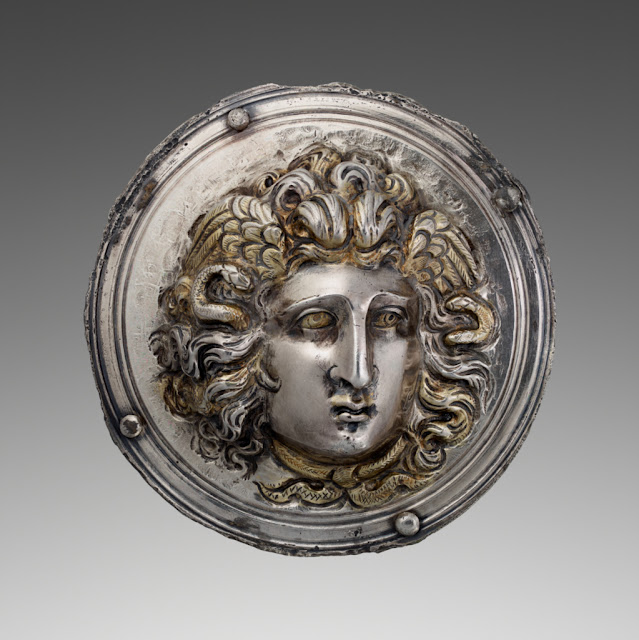
Image
While ancient Greek vase-painters and relief carvers of the Archaic Period imagined Medusa and her two immortal sisters as having monstrous form that is both male and female, human and animal, with  round faces, wide eyes, beards, and gaping mouths with extended tongues and gnashing, sharp teeth, sculptors and vase-painters of the fifth century BCE began to envisage her as being beautiful as well as terrifying and she loses the frightful teeth and beard but retains her wild hair and her uncompromising riveting gaze. In an ode written in 490 BCE, Pindar already speaks of "fair-cheeked Medusa".  Art historians attribute this to the emergence of a new artistic emphasis on the ideal form that codified standards of perfection and beauty. In fact, the depiction of a snake-haired Medusa does not become widespread until much later in the 1st century BCE, further perpetuated by the Roman poet Ovid in his Metamorphoses (4.794–803), who explains that Medusa was originally a beautiful ma...

Marsyas: The Price of Hubris

Image
One of the most moving sculptures I have ever photographed is a depiction of the satyr Marsyas who has been flayed alive by Apollo for his hubris of challenging Apollo, the god of music (among other things), to a music contest.  The large statue of Marsyas bound and hanging by his hands with his skin already partially removed at the Capitoline Museum in Rome is a Roman Imperial Period copy of a 2nd century BCE Greek original.  In antiquity, literary sources often emphasize the hubris of Marsyas and the justice of his punishment. Hubris has been described as a personality quality of extreme or foolish pride or dangerous overconfidence, often in combination with (or synonymous with) arrogance. Hubris, arrogance and pretension are related to the need for victory (even if it doesn't always mean winning). Hubris is usually perceived as a characteristic of an individual rather than a group, although the group the offender belongs to may suffer collateral consequences from wrongful a...

Minerva or Bellona?

Image
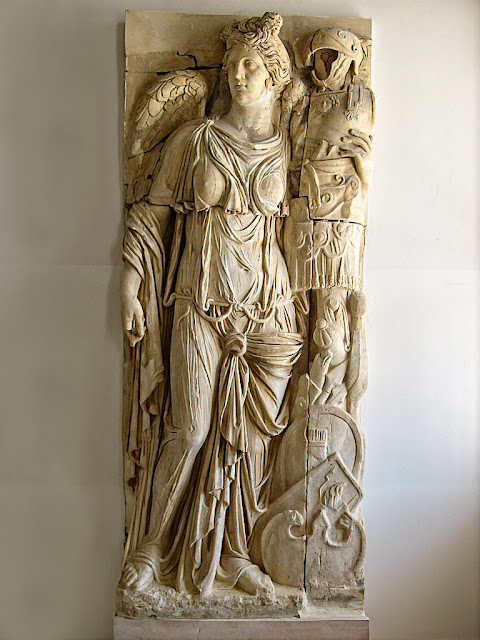
Despite the Roman association between Minerva and Athena and the frequent depiction of both goddesses with armor, unlike Athena, Minerva was not considered a war goddess in the Roman pantheon. The Romans had their own war goddess Bellona, originally an ancient Sabine goddess of war identified with Nerio, the consort of the war god Mars, and later with the Greek war goddess Enyo.  Bellona's main attribute is the military helmet that was worn on her head much like Athena.  Bellona  is often depcicted holding a sword, spear, or shield, and brandishing a torch or whip as she rides into battle in a four-horse chariot.  Bellona had a temple near the Theatre of Marcellus dedicated in 296 BCE near the Circus Flaminius by Appius Claudius Caecus, during the war with the Etruscans and Samnites. The Roman Campus Martius area, in which Bellona’s temple was situated, had extraterritorial status. Ambassadors from foreign states, who were not allowed to enter the city proper, stayed...

The "Self-Crowning Athlete"

Image
This sculpture of a self-crowning athlete may have been offered in gratitude by an athlete following a victory.  It shows a young man placing an olive wreath on his head, a symbol of victory, but also a symbol of citizenship.  The "self-crowning athlete" came to represent democracy in ancient Athens where the right to self-rule could be earned through citizenship.   The relief was found at Sounion, within the territory of the Leontis tribe.  The earliest literary reference to Sounion is in Homer's Odyssey (III. 278–285). The story recounts that as the various Greek commanders sailed back from Troy, the helmsman of the ship of King Menelaus of Sparta died at his post while rounding "Holy Sounion, Cape of Athens." Menelaus then landed at Sounion to give his companion full funeral honors with a cremation on a funeral pyre on the beach.  Sounion was fortified in the nineteenth year of the Peloponnesian War (413 BCE) for the purpose of protecting the passage of ...

The Minoan snake goddess and other "mistresses of animals"

Image
The iconic figurine of a woman holding a snake in either hand with a cat sitting on top of her head discovered by Arthur Evans in the "Pillar Shrine" within the Minoan palace of Knossus, Crete is probably one of the most instantly recognized artifacts from the Minoan world.  The original faience sculpture is displayed today at the Herakleion Archaeological Museum on Crete.  But a less well known delicate figurine composed of ivory and gold, dating from 1750 to 1580 BCE, can be seen in the Walters Art Museum in Baltimore, Maryland. In the ancient world, snakes were symbolically associated with the renewal of life because the reptile was known for sheddding its skin periodically.  This belief was shared not only by the Minoans and Pelasgians, indigenous inhabitants of the Aegean Sea region and their cultures, but by the ancient Mesopotamians and Semites as well. Within the Greek Dionysiac cult, the serpent signified wisdom and was a symbol of fertility.  Other scholars...

Owls: Symbols of Wisdom or Harbinger of Death

Image
Those of us who study the ancient world are familiar with Athena's owl and its association with wisdom and vigilance but even in the ancient world owls were not always viewed in such a positive light.  Pliny the Elder tells us Rome had to undergo a lustration, a purification of the entire city normally performed at the conclusion of the taking of the census every five years, because an owl found its way into the Capitolia. Pliny describes the owl as a funereal bird, a monster of the night and the very abomination of human kind.  Virgil describes an owl's death-howl as a precursor to Dido's death and Ovid speaks of the bird's presence as an evil omen. Surprisingly, the same viewpoint was held by the Aztecs and Maya who considered the owl a symbol of death and destruction.  The Aztec god of death, Mictlantecuhtli, was often depicted with owls.  The Popol Vuh, a Mayan religious text, describes owls as messengers of Xibalba (the Mayan "Place of Fright").  Later...

The Olympian Aegis

Image
The Olympian Aegis. According to the Iliad, both Zeus and Athena carried an aegis thought to be either a shield or animal skin adorned with the head of Medusa. The aegis was thought to have magical properies and when shook by an Olympian, would wrap clouds around Mount Ida, create claps of thunder and strike men down with fear. In the Iliad when Zeus sends Apollo to revive the wounded Hector, Apollo, holding the aegis, char ges the Achaeans, pushing them back to their ships drawn up on the shore. Roman poet Virgil described the aegis as a fearsome thing with a surface of gold like scaly snakeskin, edged with golden tassels and bearing the Gorgoneion in the central boss. But Augustus' freedman, Gaius Julius Hyginus, who became superintendent of the Palatine library, claimed it was the skin of a pet goat owned by Zeus' nurse, Amalthea, that he used as a shield when he went forth to do battle against the Titans. Images: Early Roman Imperial Zeus with Aegis and Gor...

Steelyard weights at the Metropolitan Museum of Art in New York City

Image
Steelyard weights at the Metropolitan Museum of Art in New York City. Steelyards of different sizes have been used to weigh loads ranging from ounces to tons. A small steelyard could be a foot or less in length and thus conveniently used as a portable device that merchants and traders could use to weigh small ounce-sized items of merchandise. In other cases a steelyard could be several feet long and used to weigh sacks of flour  and other commodities. Even larger steelyards were three stories tall and used to weigh fully laden horse-drawn carts. A simple steelyard balance with a lever mechanism first appeared in the ancient Near East over 5,000 years ago. The steelyard was in use among Greek craftsmen of the 5th and 4th centuries BCE, even before Archimedes demonstrated the law of the lever theoretically. The Latin name statera comes from the Ancient Greek stater. Roman and Chinese steelyards were independently invented around 200 BCE. Steelyards dating from 100 to 400 CE ha...