Posts

Showing posts with the label Assyria

Iron Age III gold cuirass fragments from Northwestern Iran, 8th-7th centuries BCE
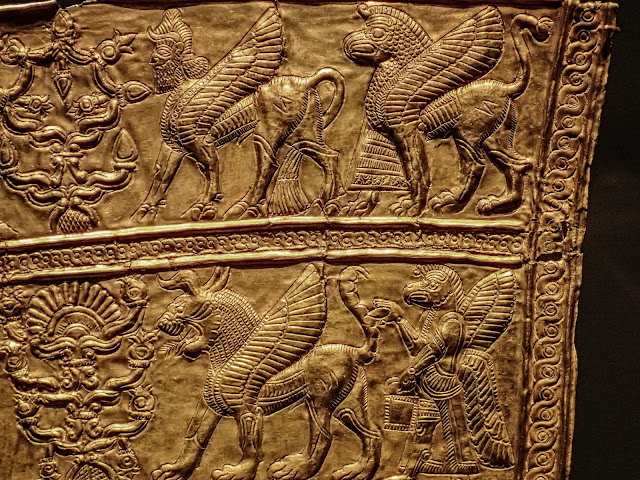
Image
In 2015, I had the opportunity to photograph artifacts in the Smithsonian's Sackler Gallery of Asian Art.  In it, I found this spectacular fragment of a gold breastplate dating to the Iron Age III period. Other fragments of this breastplate are today in the Cincinnati Art Museum and in the Royal Ontario Museum in Toronto. Fragments from a second gold breastplate found in the burial mound near the village of Ziwiye are in the Metropolitan Museum of Art and in the National Museum in Teheran. "This is a fragment from the lower part of a much larger pectoral, or breastplate, made of sheet metal and embellished with figures and ornament arranged in horizontal bands. A breastplate shielded the chest from arrows or other weapons. The decoration on this example consists of mythical guardian creatures, whose images were believed to provide magical protection for the wearer." "A pectoral made of thin sheet gold, like this one, would have been attached to a sturdier material, p...

More Urartian Art!

Image
Most of the knowledge regarding Urartu comes from a series of clay tablets found among ancient Assyrian ruins.  They hold the reports from Assyrian intelligence agents that were sent to various cities in Urartu. These clay tablets give us a record of history for a period of time around 714 BCE.  The people of Urartu referred to themselves as “Biainili.” Urartian texts have shown that the kings of Urartu often called themselves the “king of the land of Biaini,” and in Assyrian texts, Urartian kings were labeled the “king of the land of Nairi.” The land of Nairi/Biaini is known to be the land surrounding Lake Van (or the Sea of Nairi). Hebrew texts referred to Urartu as the “Kingdom of Ararat.” Historians believe that over the entire span of the kingdom’s life, people of Mitanni, Khurry, Khaldea, and Hittite blood lived among the Urartians during its early history. Its later inhabitants, those that eventually brought the kingdom to its end, were the Phrygians, Moskes, Armens, Sc...

Part of a throne with deity on a bull, ca. late 8th–7th century B.C.E., Urartian

Image
Assyrian inscriptions of Shalmaneser I (c. 1274 BCE) first mention Uruartri as one of the states of Nairi, a loose confederation of small kingdoms and tribal states in the Armenian Highlands in the thirteenth to eleventh centuries BCE which he conquered. It extended from northeastern Turkey into northwestern Iran with its cultural center around Lake Van. Its settlements were palace-fortresses that protected agricultural production and supported many crafts, especially an extensive metalworking industry.  The Nairi states were repeatedly subjected to further attacks and invasions by the Middle and Neo-Assyrian Empires.  But Urartu, united under King Arame (860-843 BCE),  reemerged in Assyrian language inscriptions in the ninth century BCE as a powerful northern rival to the Neo-Assyrian Empire. Urartologist Paul Zimansky speculated the Urartian ruling class were few in number and governed over an ethnically, culturally, and linguistically diverse population. This diversity...

Etruscan jewelry

Image
 The tomb group represents one of the richest and most impressive sets of Etruscan jewelry ever found. It comprises a splendid gold and glass pendant necklace, a pair of gold and rock-crystal disk earrings, a gold dress fastener (fibula) decorated with a sphinx, a pair of plain gold fibulae, a gold dress pin, and five finger rings. Two of the rings have engraved scarabs that revolve on a swivel bezel. One is decorated with embossed satyr heads, and the other two have decorated gold bezels. Very little jewelry from the Villanovan Era, an Early Iron Age culture dating c. 900 BCE – 700 BCE, has been discovered in modern times. The Villanovan Etruscans seem to have left few items of luxury, and thus appear modest. Yet extant Villanovan jewelry confirms that in Etruria great effort was placed in the production of decorative arts. Trade networks with the Greeks and the ancient Near East, particularly the Assyrians,  Phoenicians, and Egyptians, brought techniques such as granulation ...

Syro-Phoenician Ivories

Image
  Built by the Assyrian king Ashurnasirpal II, the palaces and storerooms of Nimrud housed thousands of pieces of carved ivory. Most of the ivories served as furniture inlays or small precious objects such as boxes. While some of them were carved in the same style as the large Assyrian reliefs lining the walls of the Northwest Palace, the majority of the ivories display images and styles related to the arts of North Syria and the Phoenician city-states. Phoenician style ivories are distinguished by their use of imagery related to Egyptian art, such as sphinxes and slender elongated figures wearing pharaonic crowns, and the use of elaborate carving techniques such as openwork and colored glass inlay. Some were also adorned with gold leaf. North Syrian style ivories tend to depict stockier figures in more dynamic compositions, carved as solid plaques with fewer added decorative elements. However, some pieces do not fit easily into any of these three styles. Most of the ivories were p...

Alectryomancy and the sacred rooster

Image
Since antiquity, the rooster has been, and still is, a sacred animal in some cultures and deeply embedded within various religious belief systems and religious worship. In ancient Babylon the rooster was considered the bird form of the True Shepherd of Anu and was considered the ordained herald of the gods. Nergal, a deity whose name meant "dunghill cock" or fighting cock, was worshipped by the Assyrians, Babylonians, Phoenicians, and Persians.  The term "Persian bird" was given to the cock by the Greeks after Persian contact "because of his great importance and his religious use among the Persians." This stems from the sacred nature of the cock, attested to in the texts of Zoroastrianism,  during the legendary Kayanian Period from about 2000 BCE to about 700 BCE.  Perhaps because of their ancient association as a divine messenger, roosters played an important role in both Etruscan and Roman religion.  Observing a rooster's willingness to eat grain ker...

The historical "Semiramis"

Image
Legends narrated by Diodorus Siculus, who drew from the works of Ctesias of Cnidus, describe an Assyrian queen named Semiramis and her relationships to Onnes and King Ninus, a mythical king of Assyria not attested to in the official Assyrian King List. This powerful queen inspired a host of monuments and place names throughout Mesopotamia, Media, Persia, the Levant, Anatolia, the Arabian Peninsula, and the Caucasus. She even became the heroine in plays, operas, and novels over the centuries. But, did she really exist? Historians, think this mythical figure actually evolved from a real queen of the Neo-Assyrian Empire named Shammuramat,  the wife of Shamshi-Adad V (reign 824 BCE–811 BCE) , who ruled as its regent for five years until her son Adad-nirari III came of age and took the reins of power. She ruled at a time of political uncertainty, and it has been speculated that her success in the male-dominated martial culture may have made the Assyrians regard her with particular rever...

The revolutionary Orientalizing Period in Mediterranean art

Image
These gold plaques depicting a winged goddess flanked by lions were created on the island of Rhodes during the so-called "orientalizing period."  This reference in art history is used to describe a development in western art beginning in the latter part of the 8th century BCE when there was a heavy influence from the art of the eastern Mediterranean including Assyria, Phoenicia, and Egypt.  During this time Greek motifs began to shift from geometric designs to the depiction of deities, animals, and mythological creatures.  Two schools of thought exist regarding the question of whether or not Geometric art itself was indebted to eastern models. In Attic pottery, the distinctive Orientalizing style known as "proto-Attic" was marked by floral and animal motifs. It was the first time discernibly Greek religious and mythological themes were represented in vase painting. The bodies of men and animals were depicted in silhouette, though their heads were drawn in outline. W...