Posts

Showing posts with the label Artemis

The myth of Kallisto and lesbianism in the Classical World
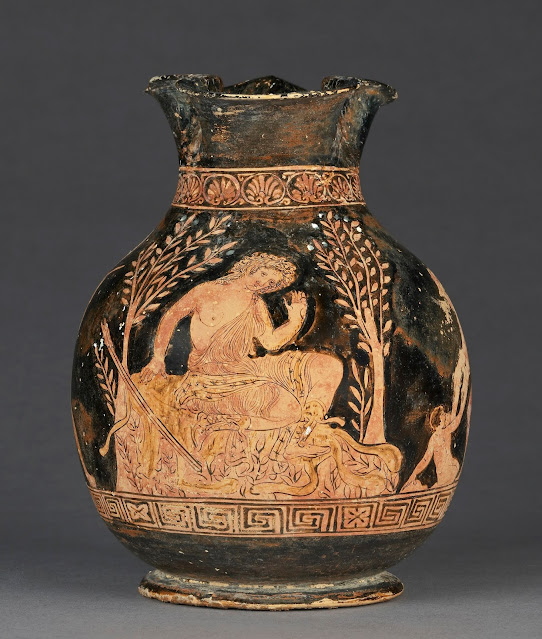
Image
According to Greco-Roman myth, the mortal virgin Kallisto (also spelled Callisto), according to Hesiod the daughter of King Lycaon of Arcadia, spent her time in the Arcadian Mountains of Greece as a favorite hunting companion of Artemis, goddess of the hunt and childbirth. Like all of Artemis' nymph companions, Kallisto had vowed to remain chaste. The king of the Greek gods, Zeus, was attracted to Kallisto (when was Zeus never attracted to all of the voluptuous females cavorting around him?) and seduced her by disguising himself as Artemis, which resulted in the birth of a son, Arkas, who gave his name to the area of Greece known as Arcadia. Artemis, angered at Kallisto's betrayal, (or, according to another version, Zeus's wife Hera, enraged with jealousy) changed Kallisto into a bear. (Yes, it's another example of the rape victim being punished for male misbehavior!) Sixteen years later, her now almost grown son, Arcas, encountered the transformed Kallisto while huntin...

The Many Faces of Artemis (Diana)

Image
 Artemis, the Greek goddess of the hunt, the wilderness, wild animals, the Moon, and chastity, was the daughter of Zeus and Leto and twin sister of Apollo.   Artemis was worshipped as one of the primary goddesses of childbirth and midwifery along with Eileithyia. Much like Athena and Hestia, Artemis preferred to remain a maiden and is sworn never to marry.  Artemis was one of the most widely venerated of the Ancient Greek deities and was assimilated into the Roman pantheon as Diana. The most important sanctuary of Diana for the ancient Romans was located at Aricia, some eleven miles outside of Rome on the shore of lake Nemi, which was known as the speculum Dianae (mirror of Diana). One of the most famous myths involving Artemis is the story of Artemis (Diana) and Actaeon.  According to the Latin version of the story told by the Roman Ovid[24] having accidentally seen Diana on Mount Cithaeron while she was bathing, he was changed by her into a stag, then pursued ...

Marsyas: The Price of Hubris

Image
One of the most moving sculptures I have ever photographed is a depiction of the satyr Marsyas who has been flayed alive by Apollo for his hubris of challenging Apollo, the god of music (among other things), to a music contest.  The large statue of Marsyas bound and hanging by his hands with his skin already partially removed at the Capitoline Museum in Rome is a Roman Imperial Period copy of a 2nd century BCE Greek original.  In antiquity, literary sources often emphasize the hubris of Marsyas and the justice of his punishment. Hubris has been described as a personality quality of extreme or foolish pride or dangerous overconfidence, often in combination with (or synonymous with) arrogance. Hubris, arrogance and pretension are related to the need for victory (even if it doesn't always mean winning). Hubris is usually perceived as a characteristic of an individual rather than a group, although the group the offender belongs to may suffer collateral consequences from wrongful a...

The Minoan snake goddess and other "mistresses of animals"

Image
The iconic figurine of a woman holding a snake in either hand with a cat sitting on top of her head discovered by Arthur Evans in the "Pillar Shrine" within the Minoan palace of Knossus, Crete is probably one of the most instantly recognized artifacts from the Minoan world.  The original faience sculpture is displayed today at the Herakleion Archaeological Museum on Crete.  But a less well known delicate figurine composed of ivory and gold, dating from 1750 to 1580 BCE, can be seen in the Walters Art Museum in Baltimore, Maryland. In the ancient world, snakes were symbolically associated with the renewal of life because the reptile was known for sheddding its skin periodically.  This belief was shared not only by the Minoans and Pelasgians, indigenous inhabitants of the Aegean Sea region and their cultures, but by the ancient Mesopotamians and Semites as well. Within the Greek Dionysiac cult, the serpent signified wisdom and was a symbol of fertility.  Other scholars...

The ancient world as Art Deco through the eyes of Paul Manship

Image
I've been doing more background research on depictions of the myth of Actaeon in Pompeii and elsewhere and stumbled across this pair of sculptures of Artemis and Actaeon produced by American artist Paul Manship.  Although I personally prefer the realism of Hellenistic art, I'm still pleased to see modern art inspired by ancient history and myth as it serves as a reminder of the foundations of our culture. These sculptures reflect this American artist's love of art history and classical themes in particular. The hunter Actaeon surprises the goddess Diana while she was bathing. To prevent him from telling anybody that he has seen her naked, the goddess fires an arrow that turns him into a stag. In the sculpture, Actaeon appears to have been just hit, with his metamorphosis into a stag just beginning, while the accompanying piece shows Diana with her bow raised. In this way, Manship created a link between the two sculptures through the flight of an unseen arrow. Paul Manship, ...

Roman mirror featuring a woodland scene with Artemis at the Art Institute of Chicago, Illinois

Image
Roman mirror featuring a woodland scene with Artemis at the Art Institute of Chicago, Illinois. Artemis (Roman Diana), or a Roman lady with divine fantasies, after her bath in a rustic, woodland setting, is the subject of the tondo in relief on the back of this Roman hand mirror. Her cloak is draped over the rocks on which she sits, and she holds the end wrapped around a small hand mirror in her raised left hand, a divine celebration of the uses of the mirror in a Roman household. The landscape in front of her, to the right, recalls the paintings and reliefs from houses around the Bay of Naples before the eruption of Mount Vesuvius in 79 CE. The quiver of the goddess leans against the base of a garlanded altar with a small herm on top. A second terminal figure, Priapis, the god of gardens and fertility, tilts back while facing to the right on the ledge at the right. The bovine skull in the right foreground suggests the sacrifice after a successful hunt.  Brass repoussé once atta...

Pompeii: The Immortal City, June 6, 2020 to September 7, 2020 at the Orlando Science Center in Orlando, Florida

Image
Pompeii: The Immortal City, June 6, 2020 to September 7, 2020 at the Orlando Science Center in Orlando, Florida. Conceived by the Galileo Museum of Florence and the National Archaeological Museum of Naples, this exhibition plunges the visitor into the heart of the drama and  ruins of the ancient city of Pompeii. Spectacular immersive moments allow the visitor to experience the destruction of the city and to identify with the inhabitants of that time, immobilized by the volcano’s ashes. Over 100 archaeological items originating from Pompeii, including a large number being exhibited for the first time, demonstrate the knowledge that the Romans had about nature as well as their scientific and technical know-how at the moment Vesuvius erupted in 79 C.E. Image: Sculpture of Artemis recovered from Pompeii at the exhibition Pompeii: The Immortal City courtesy of the exhibition company.

Apollo's twin sister Artemis "Buried by Vesuvius" at the Getty Villa until October 28, 2019

Image
Apollo's twin sister Artemis "Buried by Vesuvius" at the Getty Villa until October 28, 2019. The goddess Artemis was the daughter of Zeus, king of the gods, and the Titaness, Leto. Artemis was one of the most widely venerated of the Ancient Greek deities and her temple at Ephesus was one of the Seven Wonders of the Ancient World. In this incarnation of her, traces of copper inlay remain on the lips and she once had inset eyes.  Parts of the nose, chest, and drapery are eighteenth-century restorations. The figure has been variously identified as the Ptolemaic queen Berenike, the poet Sappho, and an Amazon. Her identification as the goddess Artemis is based on comparisons to other works, as well as the bust’s findspot near an image of Artemis’ twin brother, Apollo . This sculpture is larger and more naturalistic than the archaic style of Apollo's sculpture, however. She was found at the east end of the rectangular peristyle of the Villa dei Papiri on April 29, 1756....

Archaeological Museum of Corfu, Greece

Image
Archaeological Museum of Corfu, Greece.  The Archaeological Museum of Corfu, Greece constructed between 1962 and 1965 houses archaeological finds from the ancient city of Corfu, from the region of Cassiope and the district of Thesprotia.  These include the oldest stone pediment in Greece from the Artemis Temple of Corfu dated between 590-580 BCE, the Lion of Menecrates dated to the end of the 7th century BCE , hoplite armor and weapons, funerary monuments, votive statuettes of Artemis, ceramics, reliefs, and portrait sculpture including a Roman copy of a 3rd century BCE portrait head of Thycydides. Gorgon pediment from the Temple of Artemis 590-580 BCE hoplite armor Archaic period votive plaque Portrait head of Thucydides, Roman copy of 3rd century BCE Greek original  Images courtesy of the museum and Wikimedia Commons contributors Dr. K, and Zde