Mummy mask of a woman with corkscrew locks and bang, 50–150 CE, Roman Period Egypt
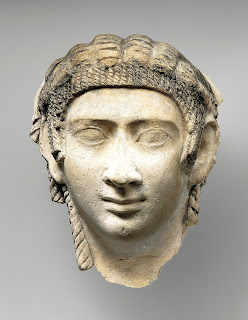
Plaster Romano-Egyptian mummy masks of the 1st - 2nd century CE appear to be individualized, much like the famous mummy portraits of the Faiyum region. But, in fact, most were made in a mold. Distinguishing details were added while the plaster was still moist with a spatula or knife. Ears were added separately and, sometimes, eyes were inlaid then the mask painted or gilded. "This woman's waved hairstyle is based on Roman court fashion, but three hanging corkscrew curls behind the ears and a short fringe of curls over the forehead and in front of the ears seem to reflect a local style. Toward the back of her head, above her ears, are traces of a smooth area that once represented a pillow. In general earlier Roman-period masks such as this one show the deceased as if reclining on a bier with the head on a pillow, while later masks have the head raised as if the deceased is rising from the bier. The underneath edge of this example is flat where it is meant to be attached to a b...
