Posts

Showing posts with the label Aristophanes

The Scythian Police Force of Athens in the 6th-4th centuries BCE

Image
The Scythian archers, called taxotai, were a hypothesized police force of 6th-, 5th- and early 4th-century BCE Athens that is recorded in some Greek artworks and literature. The force is said to have consisted of 300 armed Scythians (a nomadic people living in the Eurasian Steppe) who were public slaves in Athens. They acted for a group of eleven elected Athenian magistrates who were responsible for arrests and executions and for some aspects of public order in the city including the Assembly and the Council. Their number is said to have swelled to 1,200 at some point, so they may have also been involved in wartime conflicts as well. Scholars agree that a Scythian police force of some sort existed in Athens in the 5th century BCE and possibly as early as the 6th century BCE, although no one knows when it was first established or how long it lasted. Swiss archaeologist Balbina Bäbler points to 4th century BCE grave steles including the stele of Getes as well as buried Scythian arrowhead...

Waterfowl in Greco-Roman art

Image
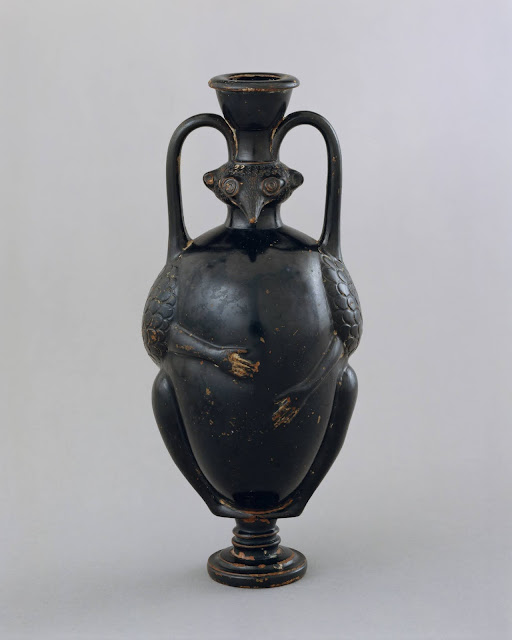
Ducks, geese, and swans were often depicted on serving ware in both Greek and Roman households. Although fish was a more common protein source than ducks and geese, even the humiliores occasionally enjoyed poultry.  Following his triumph, Caesar sponsored a public feast for 260,000 of the poorer people of Rome, offering them ducks and geese as well as seafood and game.   But waterfowl as art was used to appeal to Greek and Roman intellect as well as to their stomachs.  In addition to their inclusion in myth such as  the legendary transformation of Zeus into a swan to seduce Leda, these species appeared multiple times in popular works of Aesop and Aristophanes as they were deemed "characterful" enough to lend themselves to literary purposes.  In his play "The Birds", Aristophanes points out that a goose could act as an agent of Eros when used as a competitive gift exchanged in the homosexual courtship between an erastês and his young erômenos. Some scholars,...

Aristophanes: Comedian or Social Agitator?

Image
Aristophanes, known as "The Father of Comedy" and "the Prince of Ancient Comedy was a comic playwright of ancient Athens and a poet of what has been called Old Attic Comedy. Eleven of his forty plays survive virtually complete.  Born in 446 BC, his works, with their pungent political satire and abundance of sexual and scatological innuendo, effectively define the genre today. Aristophanes lampooned the most important personalities and institutions of his day, as can be seen, for example, in his buffoonish portrayal of Socrates in The Clouds, and in his racy anti-war farce Lysistrata.  His plays consistently espouse opposition to radical new influences in Athenian society. He caricatured leading figures in the arts (notably Euripides, whose influence on his own work however he once grudgingly acknowledged), in politics (especially the populist Cleon), and in philosophy/religion (where Socrates was the most obvious target). Such caricatures seem to imply that Aristophanes ...

Eros, swift as the whirlwinds of the tempest with his glittering wings, depicted on a bronze lamp holder, 1st century BCE, at the Dallas Museum of Art

Image
  Eros, the Greek god of love, is shown as a beautiful youth with both male and female characteristics. The figure was originally part of a lamp holder and would have had an oil lamp on the tendril he holds in an outstretched hand. The sculpture shares in the expressive, dynamic qualities of later Greek Hellenistic art; it appears to be flying on the beautifully detailed wings. The lamp from which the figure came was probably made in the eastern Mediterranean for a wealthy house or villa in Italy. The bronze has been associated with a trove of Greek luxury goods recovered from an ancient shipwreck near the town of Mahdia on the coast of Tunisia. - Anne Bromberg, Dallas Museum of Art. A cult of Eros existed in pre-classical Greece, but it was much less important than that of Aphrodite. However, in late antiquity, Eros was worshiped by a fertility cult in Thespiae. In Athens, he shared a very popular cult with Aphrodite, and the fourth day of every month was sacred to him (also share...