Posts

Showing posts with the label Aphrodite

The Meidias Painter: Art amidst the Peloponnesian War

Image
The Meidias Painter was an Athenian red-figure vase painter active in the last quarter of the 5th century BCE (fl. c. 420 to c. 400 BCE). He is named after the potter whose signature was found on a large hydria, depicting the rape of the daughters of Leucippus (Leukippos), prince of Messenia, by the Dioscuri, excavated from an Etruscan tomb.  John D. Beazley, renowned connoisseur of Greek vases, said of Meidias' work, "Here there is beauty: The gleam of gold, loves and ladies with soft limbs, in soft raiment, and all that is shining, easeful and luxurious: perfume, honey and roses."  The Meidias Painter was known for combining his theatrical “florid” style with his “flying drapery.”  He worked during the period of the Peloponnesian War and his depiction of many Attic legends, particularly those involving Erichtonios, son of Hephaistos, points to "a clear assertion of local pride prompted by the Athenians' decisive role in the fight against the barbarian" acc...

Intaglio with Scene of Aeneas and his Family Escaping from Troy

Image
While browsing the Getty's collections today I saw yet another intricately sculpted Roman cornelian gemstone from the 1st century BCE. "The gem captures the moment when Aeneas, son of the Trojan prince Anchises and the goddess Venus, escapes with his family from Troy at the end of the Trojan War. Aeneas climbs up the steps to a waiting ship, with his father over his right arm and his son, Ascanius, holding his left hand. Aeneas wears a corselet but no other armor. His father wears robes with a mantle pulled over his head. Ascanius, shown just at the moment of leaving the gates of the city, wears a Phrygian cap, a chiton, and cloak while holding a pedum (a hunter's throwing stick) over his left shoulder. Anchises holds a cylindrical box with an X pattern on the side. Behind them, the walls of Troy rise up, and a Greek solider in a crested helmets looks towards them from the battlements while holding a lit torch aloft in his raised right arm, a spear upright in his left. Thr...

Greco-Roman female portraiture

Image
Head of a woman, Greek, 200-100 BCE Marble at the Yale University Art Gallery. "In Greek and Roman female portraits, private women often imitated goddesses or queens in order to gain status and influence. This head, perhaps, echoes features of the goddess Aphrodite or the Egyptian ruler Cleopatra VII (reigned 69–30 BCE).  Although extensive damage and repairs, including a damaged nose and a missing section of hair, have made examinations of the head difficult, one can still see the resemblance to the two iconic figures." "The figure’s melon hairstyle and the beginnings of what was probably a slightly aquiline nose relate the head to portraits of Cleopatra VII who is shown with these features in her more ‘masculinized’ portraits, as in her portrait on a silver denarius in the British Museum.  At the same time, the portrait of a woman also has the classic turn of the head and soft facial features one finds in portraits of typical Greek women and of Aphrodite.  Cleopatra VI...

The Anthropological Implications of Laconian Art

Image
When scholars seek to show the role of Spartan austerity in the evolution of artistic production, they often limit themselves to objects of luxury and high prestige, supposedly condemned by the egalitarian civic ideology of the homoioi.  This raises the question, then,  of who among Spartan citizens actually produced the art.  Did Spartan citizens participate or was the art produced by the "perioikoi," a group of residents, sometimes referred to as mercenaries, living within the body of Lacedaemonians but not equal to Spartiates and yet distinct from the oppressed helots. Classicist Conrad M. Stibbe thinks we should also consider a third possibility, that Laconian art production was not a privilege of one social class or another but rather a branch of artistic industry open to all inhabitants of Laconia, whether free, less free, or unfree. Stibbe poses that archaic Sparta of the seventh and sixth centuries BCE was an open society in which artists of all kinds could freely...

"Emerging" Aphrodite

Image
This morning while searching for additional information about rare Roman funerary cippi recovered on Cyprus, I stumbled across this little figurine of "emerging" Aphrodite in the collections of the Museum of Cycladic Art. The reason it caught my attention is the pose is strikingly similar to the fresco of Venus in the triclinium of the House of the Prince of Naples that I studied earlier this year.  At the time, I was  wondering why the fresco was identified as Venus (Aphrodite) when the other main fresco in the room was identified as Bacchus (Dionysus), since Ariadne was the consort of Dionysus, not Venus.  Dr. Wallace-Hadrill had patiently explained to me that the goddess in the triclinium was identified as Venus because she is depicted wringing the sea water from her hair as described in Greek mythology (Hesiod's "Theogony" to be exact) but up until now I had never seen other ancient artwork with Venus in that particular pose. According to the museum, the eme...

Social Integration in Roman Period Egypt

Image
The social structure in Aegyptus under the Romans was both unique and complicated. On the one hand, the Romans continued to use many of the same organizational tactics that were in place under the leaders of the Ptolemaic period. At the same time, the Romans saw the Greeks in Aegyptus as “Egyptians”, an idea that both the native Egyptians and Greeks would have rejected. To further compound the whole situation, Jews, who themselves were very Hellenized overall, had their own communities, separate from both Greeks and native Egyptians. The Romans began a system of social hierarchy that revolved around ethnicity and place of residence. The Augustan takeover introduced a system of compulsory public service, which was based on poros (property or income qualification), which was wholly based on social status and power. Other than Roman citizens, a Greek citizen of one of the Greek cities had the highest status, and a rural Egyptian would be in the lowest class. In between those classes was t...

Aphrodite of the East - A warrior love goddess

Image
The cult of Aphrodite in Greece was imported from, or at least influenced by, the cult of Astarte in Phoenicia, which, in turn, was influenced by the cult of the Mesopotamian goddess known as "Ishtar" to the East Semitic peoples and as "Inanna" to the Sumerians. Pausanias states that the first to establish a cult of Aphrodite were the Assyrians, followed by the Paphians of Cyprus and then the Phoenicians at Ascalon. The Phoenicians, in turn, taught her worship to the people of Cythera. Aphrodite took on Inanna-Ishtar's associations with sexuality and procreation. Furthermore, she was known as Ourania, which means "heavenly", a title corresponding to Inanna's role as the Queen of Heaven. Early artistic and literary portrayals of Aphrodite are extremely similar on Inanna-Ishtar. Like Inanna-Ishtar, Aphrodite was also a warrior goddess. The second-century CE Greek geographer Pausanias records that, in Sparta, Aphrodite was worshipped as Aphrodite Arei...

Eros and Psyche: Love and the betrayal of trust

Image
Although we often see Eros, Roman Cupid, depicted as a chubby little winged child, he was also prominently portrayed in ancient literature as the adult husband of Psyche.  The longstanding folktale, codified in Apuleius' Latin novel, The Golden Ass, relates a quest for love and trust between Eros and Psyche. Aphrodite was jealous of the beauty of the mortal princess Psyche, as men were leaving her altars barren to worship a mere human woman instead, and so Aphrodite commanded her son Eros, the god of love, to cause Psyche to fall in love with the ugliest creature on earth. But instead, Eros falls in love with Psyche himself and spirits her away to his home. Their fragile peace is ruined by a visit from Psyche's jealous sisters, who cause Psyche to betray the trust of her husband. Wounded, Eros leaves his wife, and Psyche wanders the Earth, looking for her lost love. Eventually, she approaches Aphrodite and asks for her help. Aphrodite imposes a series of difficult tasks on Psy...

Isis-Aphrodite, Roman symbols of fertility and rebirth in the Second Century CE

Image
Isis-Aphrodite is a form of the great goddess Isis that emphasizes the fertility aspects associated with Aphrodite. She was concerned with marriage and childbirth and, following very ancient pharaonic prototypes, also with rebirth. Figures depicting this goddess are found in both domestic and funerary contexts. Popular already in the 3rd to 2nd centuries B.C., they continued to be made in Roman times. Dating technology places these pieces in the Roman period. These statuettes were created between 161 - 180 CE and are thought to be possibly reflecting the image of Empress Faustina Minor, wife of Marcus Aurelius. Statuettes with a vulture cap have been found in both Egypt and Syria. Images courtesy of The Metropolitan Museum of Art. Isis-Aphrodite resembling the Roman Empress Faustina Minor, wife of Marcus Aurelius, 1st - 2nd century CE Egypt Isis-Aphrodite with vulture cap that resembles Roman Empress Faustina Minor wife of Marcus Aurelius 161-180 CE Egypt

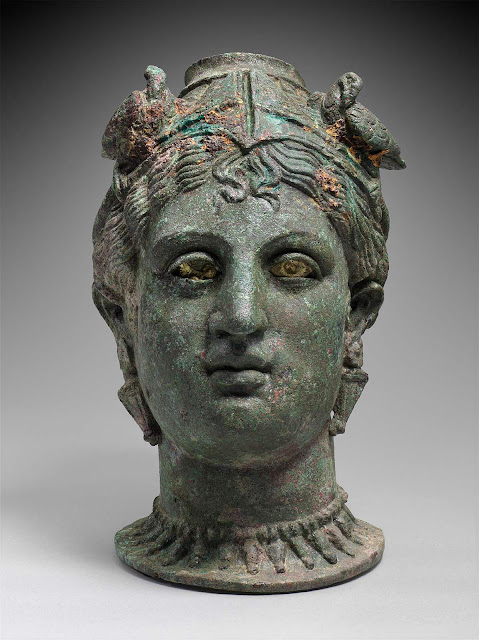
Perfume jar (balsamarium) in the shape of a female head (Aphrodite or Turan?) late 3rd to early 2nd century BCE Italic, Etruscan at the Museum of Fine Arts Boston

Image
Perfume jar (balsamarium) in the shape of a female head (Aphrodite or Turan?) late 3rd to early 2nd century BCE Italic, Etruscan at the Museum of Fine Arts Boston.  This balsamarium or perfume vase is in the shape of a woman's head, most likely the goddess of love, Turan or the Lassae, Etruscan spirits of beauty who waited on divine and mortal women at their toilet. As it was found in a tomb in Etruria (between Ferentinum and Bomarzo), most likely it was a prized possession of a wealthy Etruscan lady. The head is decorated with a diadem with two doves (associated with the worship of Aphrodite), elongated drop earrings, and a necklace of pendants. The eyes were inserted--probably glass irises were set into a fine lime paste. The base is decorated with a rosette.  It was purchased from collector Edward petty Warren for over $69,000.  Its dimensions are 4 1/8 by 3 by 2 1/2 inches. Perfume jar (balsamarium) in the shape of a female head (Aphrodite or Turan?) late 3rd t...

Bronze mirror from the Peloponnesos circa 460 BCE

Image
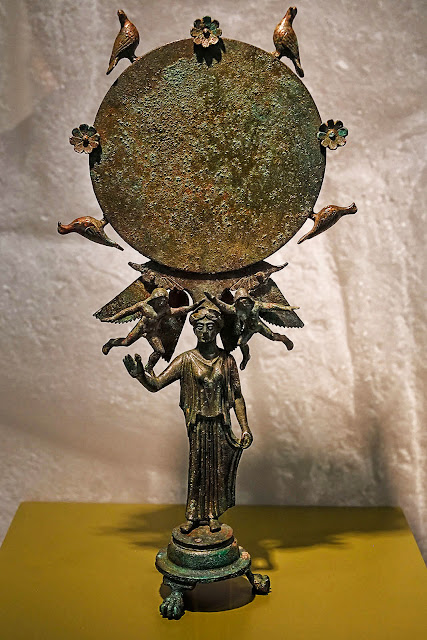
Bronze mirror from the Peloponnesos circa 460 BCE (Inv 566) Surrounded by flowers and pigeons, this mirror features a handle depicting Aphrodite accompanied by two Erotes. It is part of the permanent collection of the Allard Pierson Museum in Amsterdam courtesy of Wikimedia Commons contributor Dick Osseman. Bronze mirror with Aphrodite handle at the Allard Pierson Museum in Amsterdam courtesy of Dick Osseman. Closeup of  Bronze mirror with Aphrodite handle at the Allard Pierson Museum in Amsterdam courtesy of Dick Osseman.