Posts

Showing posts with the label Amorite

First Look: Mesopotamia: Civilization Begins at the newly reopened Getty Villa

Image
Today's featured "Antiquities Alive" virtual exhibit - The first batch of images from my friend Allan Gluck of the "Mesopotamia: Civilization Begins" exhibit at the newly reopened Getty Villa:   Head of a God, Neo-Sumerian, 2150-2000 BCE, Terracotta, now in the collections of the Louvre, courtesy of Allan Gluck Head of a Man, possibly a ruler, Sumerian, 2700-2600 BCE, Limestone, now in the collections of the Louvre, courtesy of Allan Gluck Head of a ruler, Amorite, about 1840 BCE, Gabbro, now in the collections of the Louvre, courtesy of Allan Gluck Bronze model of a chariot, Sumerian, 2900 - 2340 BCE, now in the collections of the Louvre, courtesy of Allan Gluck Plaque with King Gilgamesh killing the monster Humbaba, Amorite, 2000 - 1600 BCE, terracotta, now in the collections of the Louvre, courtesy of Allan Gluck Relief fragment with royal chariot and officers, Neo-Assyrian, 668-627 BCE, Gypsum, now in the collections of the Louvre, courtesy of Allan Gluck St...
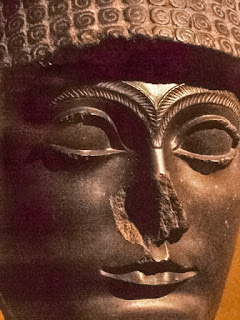
Mesopotamia: Civilization Begins exhibit now open at the Getty Villa in Pacific Palisades, California

Image
The Getty Villa has reopened and is now hosting the special exhibit "Mesopotamia: Civilization Begins."  Some of the objects are from the Metropolitan Museum of Art in New York.  Others are on loan from The Louvre and the Bibliothèque Nationale de France. Ancient Mesopotamia, centered in present-day Iraq, occupies a unique place in the history of human culture. It is there, around 3400–3000 BC, that all the key elements of urban civilization first appear in one place: cities with monumental infrastructure and official bureaucracies overseeing agricultural, economic, and religious activities; the earliest known system of writing; and sophisticated architecture, arts, and technologies. For some three thousand years, Mesopotamia remained the preeminent force in the Near East. In 539 BC, however, Cyrus the Great captured Babylon and incorporated Mesopotamia into the Persian Empire. Periods of Greek and Parthian rule followed, and by about AD 100 Mesopotamian culture had effective...