Posts

Showing posts with the label Alexander the Great

The Syncretization of Zeus Ammon and the Oracle of Siwa

Image
Zeus was identified with the Roman god Jupiter and associated in the syncretic classical imagination with various other deities, such as the Etruscan Tinia and the Egyptian Amun (Ammon). He, along with Dionysus, absorbed the role of the chief Phrygian god Sabazios as well in the syncretic deity known in Rome as Sabazius. Ammon was origiinally a Libyan deity.  His oracle, situated in the Siwa oasis, 500 kilometers west of Memphis became known by the Egyptians as "Amun of Siwa, lord of good counsel." Siwa is believed to have been occupied as early as Paleolithic and Neolithic times, and some believe at one time it was the capital of an ancient kingdom that may have included Qara, Arashieh and Bahrein.  According to one myth the temple at Siwa was founded by the Greek god Dionysus. While lost in the Western Desert, Dionysus was perishing of thirst when a man appeared and guided him to the spring at Aghurmi. In gratitude, Dionysus erected the temple. In other myths, the Oracle of...

Protesilaus: The first Greek to die in the Trojan War

Image
Protesilaus (also spelled Protesilaos) was one of the suitors of Helen of Troy sworn to defend the honor of Menelaus. He brought forty black ships with him to Troy, drawing his men from "flowering" Pyrasus, coastal Antron, and Pteleus, "deep in grass", in addition to his native Phylace in ancient Thessaly. Protesilaus was "the first man who dared to leap ashore when the Greek fleet touched the Troad", Pausanias recalled, quoting the author of the epic called The Cypria.  An oracle had prophesied that the first Greek to walk on the land after stepping off a ship in the Trojan War would be the first to die, and so, after killing four men, he was himself slain by Hector. (Alternate sources have him slain by either Aeneas, Euphorbus, Achates, or Cycnus.)  The gods had pity on his widow, Laodamia, daughter of Acastus, and brought him up from Hades to see her. She was at first overjoyed, thinking he had returned from Troy, but after the gods returned him to the ...

Germanic or Gallo-Roman prick spur, 2nd - 3rd century CE

Image
Early spurs had a neck that ended in a point, called a prick, riveted to the heel band. The spur was used by the Celts during the La Tène period (which began in the fifth century BCE), and is also mentioned by Xenophon (circa 430 - 354 BCE.) in his treatise "On Horsemanship".   When the horse is about to leap over any obstacle, Xenophon recommends applying the spur on takeoff, so that the horse will use his whole body over the obstacle and make a safer jump. If this is not done, Xenophon points out, he may lag with his hind end. Xenophon goes on to admonish those wishing to make a horse "showy" to spare the spur. He emphasized that the rider should not pull on the bit nor spur or whip the horse, as this type of riding causes the opposite effect, simply distracting and frightening the animal and causing him to dislike being ridden. Instead, Xenophon urges, the horse must enjoy himself. He should be trained to be ridden on a loose rein, to hold his head high, arch his...

The iconic kausia hat of ancient Macedon

Image
 While researching artwork of ancient Macedon this morning, I stumbled across an interesting image of a 3rd Century BCE Macedonian wearing a kausia, headgear said by some scholars to be adapted from a style worn in the Hindu Kush during Alexander the Great's campaign there.  Other scholars think the kausia was identified with Macedonia for too long to have been imported from Asia.   Depictions of the kausia can be found on a variety of coins and statues found from the Mediterranean to the Greco-Bactrian kingdom and the Indo-Greeks in northwestern India. The Persians referred to both the rest of the Greeks and Macedonians as "Yauna" (Ionians), but made a distinction between "Yauna by the sea" and those "with hats that look like shields" (yauna takabara), probably referring to the Macedonian kausia hat.  You can see Alexander himself wearing a kausia and fighting an Asiatic lion with his friend Craterus in a late 4th century BCE mosaic from Pella as well...

Miniature from the tomb of Alexander IV

Image
Ivory and gold miniature of the Thracian deity Sabazios from the Tomb of Alexander IV, 311 BCE in Aigai, Macedonia. According to the Archaeological Museum of Aigai, the garments worn by this half-man, half-plant demon-like figure point to Sabazios, a Thracian deity identified with Dionysos.  This hybrid creature, with both Greek and Oriental features, is typical of art of the Hellenistic Period (323-31 BCE).  Celebrating the coexistence and synthesis of different cultures, it reflects the unity Alexander imposed on his empire. This miniature was part of the rich decoration on a couch found in Alexander IV's tomb.  Alexander IV, the son of Alexander the Great, with a Macedonian father and Bactrian mother, was a good example of this unity.  Sadly, he was assassinated at the age of only 12 (others say 14), before he could take his father's throne by an officer of his father's Companion cavalry on the orders of Cassander.  His tomb is thought to be among the royal t...

Buddhist sculpture of the 4th and 5th centuries CE

Image
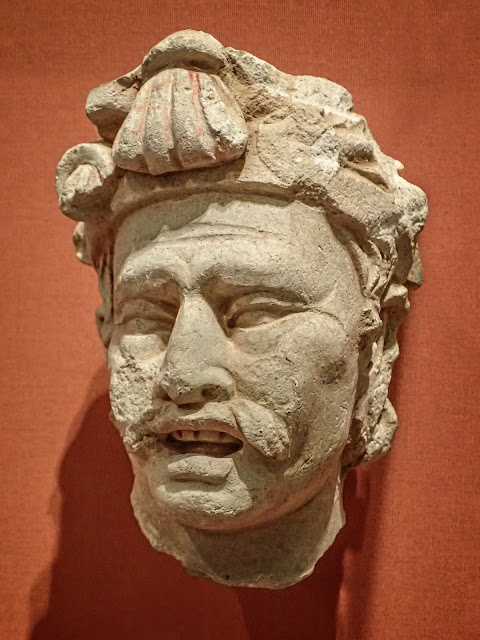
Buddhist monuments of the 4th and 5th century CE were decorated with elaborate scenes in stucco.  The heads were sometimes made separately and pegged in place, so they often became detached. This Head may be Kuvera or possibly a warrior belonging to the army of the evil god Mara, a demonic celestial king who tempted Prince Siddhartha (Gautama Buddha) by trying to seduce him with the vision of beautiful women who, in various legends, are often said to be Mara's daughters.  In Buddhist cosmology, Mara is associated with death, rebirth and desire. Modeled of lime composition, this sculpture reflecting Hellenistic influence introduced into the region by Alexander the Great, was found in Hadda, Afghanistan and is part of the collections of the Victoria and Albert Museum in London that I photographed in 2016.

Kudurrus of ancient Babylon

Image
A kudurrus is an ancient Babylonian stone with an inscription that records a land grant, usually between the ruling monarch and a subject.  It's name is derived from kudurru, the Akkadian word for boundary.  The only kudurrus excavated in ancient Babylonian sites were found in temples where they would have served to record the transaction and to protect the rights of owner by legal as well as divine means. Inscriptions usually provided the location of the plot of land, the boundaries of its four sides, the name of the surveyor of the property and the names of witnesses to the transaction. To provide divine protection of the relationship, a kudurrus also often included many symbols of deities such as the crescent, symbol of the moon-god Sin, the solar disk of the sun god Shamash, and the eight-pointed star of the goddess Ishtar/Inanna. A Kassite example I photographed at the Oriental Institute of the University of Chicago was cast from an original in the British Museum.  T...

Palace of Philip II to be reopened for visitors in 2021

Image
In the summer of 2021, the palace where Alexander the Great was born, will be open for visitors although the visitor's center will not be completed until 2023. Alexander the Great, otherwise referred to as the “King of Kings”, was born on July 20 or 21, 356 BCE. in Pella, Macedonia. He led a Pan-Hellenic military campaign against Persia and in the process spread Greek culture across the entire empire he created. The palace originally encompassed about 70 acres but was looted by the Romans when the Macedonians were defeated in 168 BCE. The structure harkens back to the style of Mycenean palace-complexes and doubled as a fortified stronghold with town inhabitants, while also having particular sectors built for royal burials. Added to this high-density usage pattern, the ancient complex occupied a rather strategic site defined by two rivers and the Pieria mountains. This military significance of the stronghold mirrored the desperate political situation originally faced by Philip II, A...

Horse Trappings in the time of Alexander the Great

Image
The power of mobility  given by mounted units in warfare was recognized early on, but was offset by the difficulty of raising large forces and by the inability of horses (then mostly small) to carry heavy armor. Nonetheless, there are indications that, from the 15th century BCE onwards, horseback riding was practiced amongst the military elites of the great states of the ancient Near East, most notably those in Egypt, Assyria, the Hittite Empire, and Mycenaean Greece. Cavalry techniques, and the rise of true cavalry, were an innovation of equestrian nomads of the Central Asian and Iranian steppe and pastoralist tribes such as the Iranic Parthians and Sarmatians.  Initially, riders had no spurs, saddles, saddle cloths, or stirrups. Fighting from the back of a horse was much more difficult than mere riding. The cavalry acted in pairs. The reins of the mounted archer were controlled by his neighbor's hand. Even so, at this early time, cavalry used swords, shields, spears, and bo...

The bit that controlled the mighty Bucephalus

Image
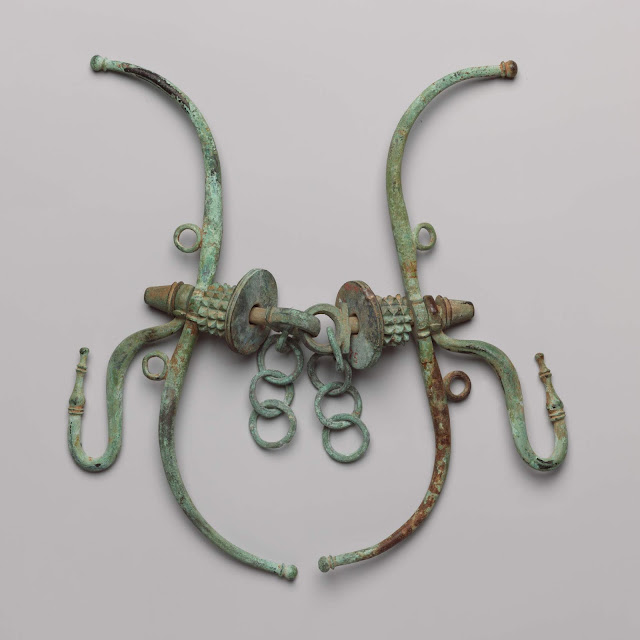
There is evidence of the use of bits to control horses, located in two sites of the Botai culture in ancient Kazakhstan, dated about 3500–3000 BCE.  Nose rings appear on the equids portrayed on the Standard of Ur, circa 2600–2400 BCE. To date, the earliest known artistic evidence of use of some form of bitless bridle comes in illustrations of Synian (Syrian?) horseman, dated approximately 1400 BCE.  Metal bits came into use between 1300 and 1200 BCE, originally made of bronze.   The need for control of horses in warfare drove extensive innovation in bit design, producing a variety of prototypes and styles over the centuries. This bit is of a distinctive type attested in Northern Greece and used for horses that are ridden rather than driven. Its most noteworthy occurrence is on the mount of Alexander of Macedon in the famous Alexander mosaic from the Casa del Fauno in Pompeii and now in the Archaeological Museum, Naples. Bronze bit, Greek, 4th-3rd century BCE at...

The Greeks, From Agamemnon to Alexander the Great,” through September 15, 2019 at the Hangaram Museum in Seoul, South Korea

Image
“The Greeks, From Agamemnon to Alexander the Great,” through September 15, 2019 at the Hangaram Museum in Seoul, South Korea. This exhibit features 350 ancient Greek artifacts including funerary helmets with gold death masks from the mid-6th century BCE, votive sculpture, grave goods of 9th century BCE Macedonian aristocrats, gold serving ware and seal rings, ceramics featuring scenes from Homer's Odyssey, and a gold myrtle wre ath from a priestly warrior of Stavroupolis, companion to the king of 4th century BCE Macedon. I had the privilege of attending this marvelous exhibition when it was displayed at The Field Museum in Chicago, Illinois in 2016. I was astonished by the wealth of the grave goods on display and I particularly liked the way the grave goods were exhibited, placed in the position they were found in the burial chamber. Be sure to examine even the small items carefully, too. I was thrilled to see a small but beautifully carved Gorgon that was said to come from the b...