Posts

Showing posts with the label Africa

Africans in Greek and Roman Art

Image
The Bronze Age Minoans of Crete were probably the first Greeks to come into contact with Ethiopians, a Greek name meaning those with "burnt" faces.  The tomb of Rekhmire, governor of Thebes and vizier during the reigns of the pharaohs Thutmosis III and Amenhotep II, circa 1400 BCE, includes one of the earliest depictions of both African and Aegean peoples, thought to be Nubians and Minoans.  However, the collapse at the end of the Late Bronze Age severed Greek connections with Egypt and even the Near East. Trade between the Greeks and the northern periphery of Africa finally resumed in the 8th and 7th centuries BCE including the establishment of trading centers along the Nile and at Cyrene on the northern coast of Africa. Then depictions of Africans began to appear in Aegean art. All black Africans were known as Ethiopians to the ancient Greeks, as the fifth-century BCE historian Herodotus tells us, with their black skin color being the primary identifying physical characteri...

Penn Museum to reopen July 28, 2020!

Image
Today's featured "Antiquities Alive" exhibit:  The Penn Museum (University of Pennsylvania Museum of Archaeology and Anthropology) will reopen to the public on July 28, 2020!  Here's a selection of images I have taken of their marvelous collections! Dionysos with lion garden statuary from Latium region of Italy Roman marble Etruscan Sarcophagus 3rd century BCE Mosaic thought to depict Theseus sailing away from the Cretan labyrinth, Utica, Tunisia, First half of the 3rd century CE Roman Theater Mask of a River God from a bath complex in Teano (southern Italy) Flavian Period limestone Recarved image of Ramesses II excavated at Harsaphes, Heracleopolis, Egypt 1897-1843 BCE Gilded Cartonnage Funerary Mask Ptolemaic or Roman Period ancient Egypt Plaster funerary portrait bust of a man from El Kharga (upper) Egypt Roman Period 2nd century CE Painted Pottery Horses Tang Dynasty China 7th to 10th century BCE Guanyin Jin Dynasty (1115-1234 CE or Yuan Dynasty (1271-1368 CE) Chi...

Terracotta jug in the shape of an African head, Roman Cyprus, 3rd century CE at the Metropolitan Museum of Art in New York City

Image
Terracotta jug in the shape of an African head, Roman Cyprus, 3rd century CE at the Metropolitan Museum of Art in New York City. The unique geographic location of Cyprus at the crossroads of seafaring trade in the eastern Mediterranean made it an important center for trade and commerce in antiquity. Already in the Early Bronze Age (ca. 2500–1900 B.C.) and Middle Bronze Age (ca. 1900–1600 B.C.), Cyprus had established contacts w ith Minoan Crete and, subsequently, Mycenaean Greece, as well as with the ancient civilizations of the Near East (Syria and Palestine), Egypt, and southern Anatolia. In 570 BCE, Cyprus was conquered by Egypt under Amasis II. This brief period of Egyptian domination left its influence mainly in the arts. Some ceramics recovered on Cyprus feature men wearing Egyptian wigs and Assyrian-style beards. The influence of Egypt would continue during and after the wars of Alexander's successors. The largest city and kingdom of Cyprus, Salamis, strongly supported P...

Sahel: Art and Empires on the Shores of the Sahara, January 30 - May 10, 2020 at The Metropolitan Museum of Art in New York City

Image
Sahel: Art and Empires on the Shores of the Sahara, January 30 - May 10, 2020 at The Metropolitan Museum of Art in New York City. From the first millennium, the western Sahel—a vast region in Africa just south of the Sahara Desert that spans what is today Senegal, Mali, Mauritania, and Niger—was the birthplace of a succession of influential polities. Fueled by a network of global trade routes extending across the region, the emp ires of Ghana (300–1200), Mali (1230–1600), Songhay (1464–1591), and Segu (1640–1861) cultivated an enormously rich material culture. Sahel: Art and Empires on the Shores of the Sahara will be the first exhibition of its kind to trace the legacy of those mighty states and what they produced in the visual arts. The presentation will bring into focus transformative developments—such as the rise and fall of political dynasties, and the arrival of Islam—through some two hundred objects, including sculptures in wood, stone, fired clay, and bronze; objects in gol...

Greco-Roman, African, and Asian antiquities at the Ackland Art Museum of the University of North Carolina at Chapel Hill

Image
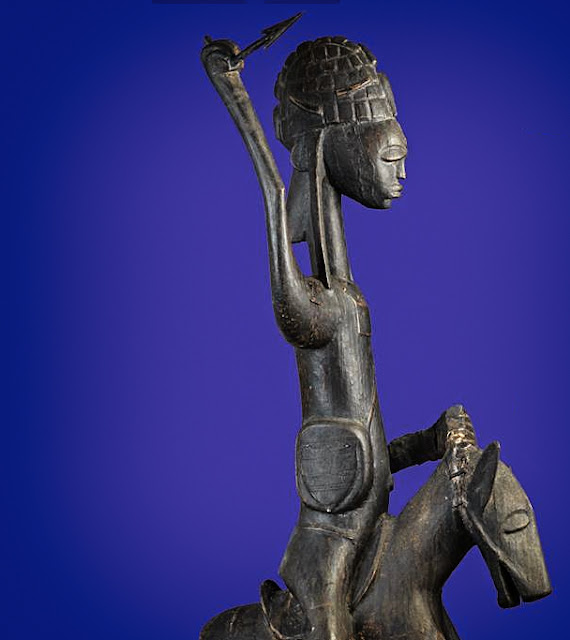
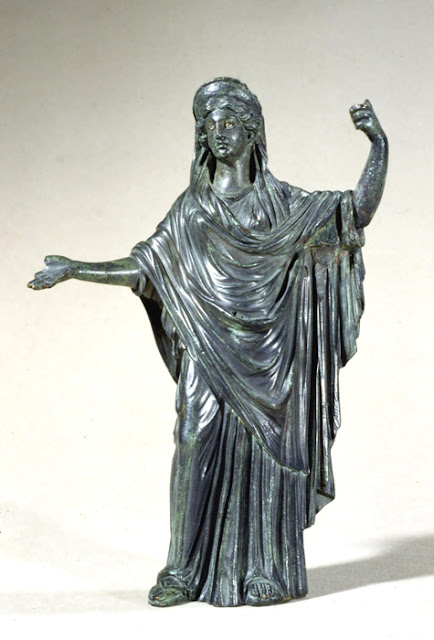
Greco-Roman, African, and Asian antiquities at the Ackland Art Museum of the University of North Carolina at Chapel Hill. The collection of the Ackland Art Museum includes over 19,000 works of art. It's ancient works of art include sculpture, glassware, coins, jewelry and ceramics dating as far back as the second millennium. Among some of the more unusual pieces, is a sculpture of a man carrying a fish identified as possibly 4 th century CE Anglo Roman. The African collection includes a sculpture created by the Nok culture of ancient Nigeria dated from 100 BCE - 200 CE. Also, don't miss a painting of a peasant offering Cleopatra VII a basket of figs with an asp by French artist Eugène Delacroix painted in 1838. Images: The goddess Juno, Roman, bronze, 150-200 CE, Man carrying a fish, 4th century CE, Anglo-Roman, and a Nok figural sculpture from ancient Nigeria 100 BCE - 200 CE. All images courtesy of the museum.

Art from the ancient Mediterranean, Africa, East Asia, Middle East, and the Americas at The Walters Art Museum in Baltimore, Maryland

Image
Art from the ancient Mediterranean, Africa, East Asia, Middle East, and the Americas at The Walters Art Museum in Baltimore, Maryland. The Walters Art Museum, with its 36,000 objects that span a broad arc of time, geography, and culture, has become a national leader in arts education and is totally free at all times for all members of the public. The Walters’ Conservation and Technical Research department, founded in 1934, is the third oldest museum laboratory in the country. Some of its outstanding artifacts include one of the largest collections of Roman sarcophagi in the U.S., the mummy mask of a handsome high official of the 11th dynasty of Middle Kingdom Egypt, and the glittering Greek gold of the Olbia Treasure. Image: Exquisite gold bracelet with garnets amethysts and emeralds from the Olbia Treasure in modern day Ukraine Greek 2nd-1st century BCE. Photographed at the Walters Art Museum. Note: If you are visiting Washington D.C., Baltimore is just a short train ri...

Arts of Africa and the Americas. Ongoing. At the Minneapolis Institute of Art. Minneapolis, Minnesota

Image
Arts of Africa and the Americas. Ongoing. At the Minneapolis Institute of Art. Minneapolis, Minnesota Bronze Graeco-Egyptian sculpture of a Ptolemaic ruler in the guise of Herakles 2nd century BCE. Image courtesy of the Minneapolis Institute of Art in Minneapolis, Minnesota. The Arts of Africa and the Americas Department is dedicated to the immense creativity of Native peoples across the world, from prehistory to the present. The collection has grown significantly since the department was founded more than 30 years ago, and now numbers more than 5,500 objects, including masterworks of sculpture, ceram ics, textiles, metalsmithing, painting, basketry, and bead, shell, and quillwork, reflecting the diversity of these regions and cultures.

Ancient Art of the Americas, Africa, and Asia. Ongoing. At the Fowler Museum on the campus of the University of California, Los Angeles

Image
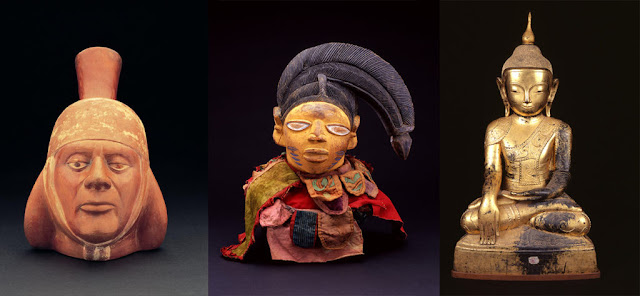
Ancient Art of the Americas, Africa, and Asia. Ongoing. At the Fowler Museum on the campus of the University of California, Los Angeles. - The Fowler’s collections comprise more than 120,000 art and ethnographic and 600,000 archaeological objects representing ancient, traditional, and contemporary cultures of Africa, Native and Latin America, and Asia and the Pacific.  The Fowler’s collections comprise more than 120,000 art and ethnographic and 600,000 archaeological objects representing ancient, traditional, and contemporary cultures of Africa, Native and Latin America, and Asia and the Pacific. From Yoruba beaded arts of Southern Nigeria, to pre-Columbian ceramic vessels of Peru. Read even more!