Posts

Showing posts with the label weapon

Hannibal's Secret Weapons

Image
 My friend Patrick Hunt from Stanford University presented this lecture in June for the Archaeological Institute of America.  Before I retired, Patrick kindly invited me to join him on one of his National Geographic-sponsored expeditions in the Alps but I had just returned to work after six months recuperation from a serious fall in Naples. I was afraid I wouldn't be able to keep up with his cohort of burly Stanford athletes at the 8,000 foot altitude of the Clapier-Savine Coche pass. I really enjoyed this lecture and learned some interesting information about the battle of Cannae that I must have overlooked.  Patrick points out that at the battle of Cannae Hannibal took advantage of a seasonal dust storm that is known to blow sand from the Sahara desert into Italy at that time of the year and positioned his troops so that the wind was at their back while it was blowing in the faces of the Romans.  He also mentioned that Hannibal used troops dressed in captured Roman...
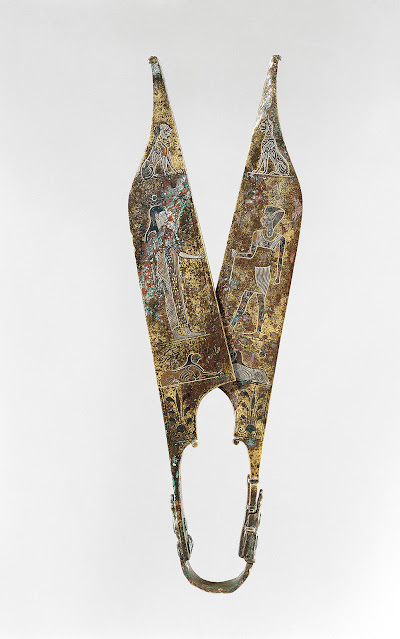
Roman scissors and the scissores gladiator

Image
The earliest known scissors appeared in Mesopotamia 3,000 to 4,000 years ago. These were of the 'spring scissor' type comprising two bronze blades connected at the handles by a thin, flexible strip of curved bronze which served to hold the blades in alignment, to allow them to be squeezed together, and to pull them apart when released. Spring scissors continued to be used in Europe until the 16th century. However, pivoted scissors of bronze or iron, in which the blades were pivoted at a point between the tips and the handles, the direct ancestor of modern scissors, were invented by the Romans around 100 CE. They entered common use in not only ancient Rome, but also China, Japan, and Korea. A specialized weapon known as a scissor was also used by a class of gladiators called scissores. It consisted of a long, thin cylindrical-shaped pipe terminating in a crescent-shaped blade. A handle inside the tube allowed the gladiator to maintain control. The shape of the blade could produc...

The Vermand Treasure

Image
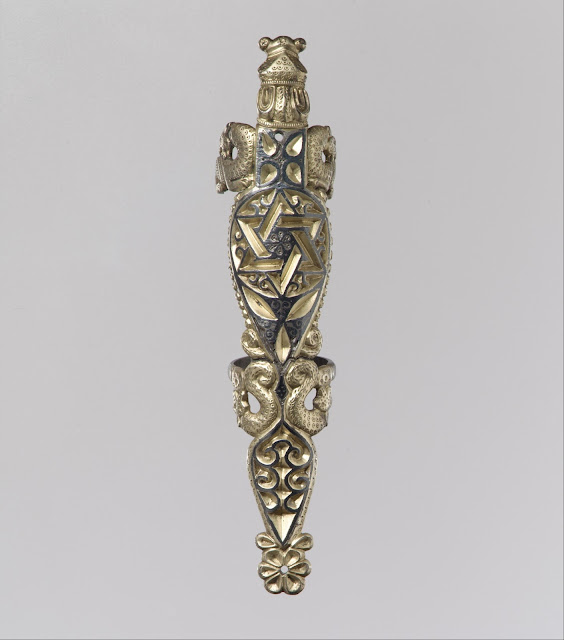
The Vermand Treasure was discovered in the last quarter of the nineteenth century by Benoni Lelaurain.  It was recovered from a cemetery near the modern village of Vermand, which is located beside the Celtic oppidum of Viromandui.  In the 3rd century CE, Vermand served as a castra hiberna within the network of provincial Roman border defenses. It was also a thriving glass production center and home to a large number of refugees following the destruction of Augusta Viromanduorum in the late 3rd century by barabarian invaders. The treasure was found in one of the few military burials in the cemetery.  However, grave robbers had previously plundered the burial, cracked the stone sarcophagus and scattered the contents. Perhaps they had been interrupted in their violation of the grave as six objects including this gilt silver spear shaft mount were left behind.  Others, documented in the excavation report, remained as well but it is thought the excavator's workmen pilf...