Posts

Showing posts with the label serpent

The Storm God of the Hatti then Hittite
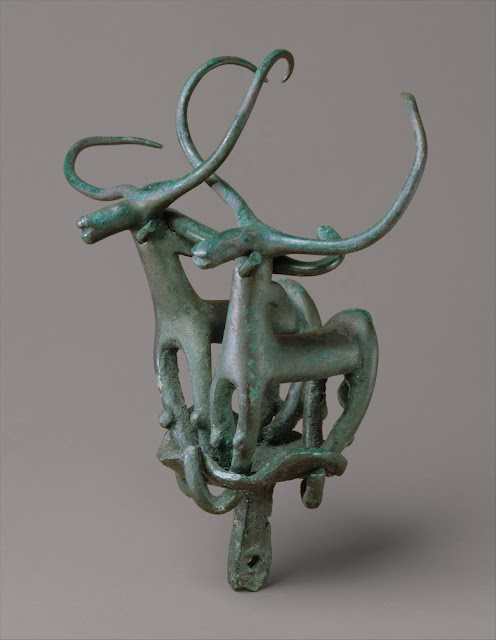
Image
During the early Bronze Age the Hatti, who were neither Semitic nor Indo-European, inhabited central Anatolia. They were actually distinct from the Hittite but as the Hittite expanded beginning about 2000 BCE, the Hatti were gradually absorbed into the Hittite political and social order.  The Hatti were organized in monarchical city-states. These states were ruled as theocratic kingdoms or principalities. Hatti regions of Anatolia came to be influenced by mighty Mesopotamian polities, in the form the Akkadian Empire (24th-22nd century BCE) and the succeeding Old Assyrian Empire (21st-18th century BCE), both of which set up trading colonies called karum, located throughout eastern and central Anatolia. During the first centuries of the 2nd millennium BCE, an Assyrian trade colony existed in the city of Hattush, and several Assyrian inscriptions mention the existence of local rulers (kings) of Hattush, also referring to their relations with other city-states in the region. Fortunatel...

Heracles (Hercules) and the Lernaean Hydra

Image
The Lernaean Hydra or Hydra of Lerna more often known simply as the Hydra, is a serpentine water monster in Greek and Roman mythology. Its lair was the lake of Lerna in the Argolid. Lerna was reputed to be an entrance to the Underworld, and archaeology has established it as a sacred site older than Mycenaean Argos. In the canonical Hydra myth, the monster is killed by Heracles (Hercules) as the second of his Twelve Labors. The oldest extant Hydra narrative appears in Hesiod's Theogony, while the oldest images of the monster are found on a pair of bronze fibulae dating to c. 700 BCE. In both these sources, the main motifs of the Hydra myth are already present: a multi-headed serpent that is slain by Heracles and Iolaus. While these fibulae portray a six-headed Hydra, its number of heads was first fixed in writing by Alcaeus (c. 600 BCE), who gave it nine heads. Simonides, writing a century later, increased the number to fifty, while Euripides, Virgil, and others did not give an exac...

Achelous and the origins of the Horn of Plenty

Image
 In ancient Greek religion and mythology, the god Achelous (also Acheloos or Acheloios) was associated with the Achelous River, the largest river in Greece. According to Hesiod, he was the son of the Titans Oceanus and Tethys. He was also said to be the father of the Sirens, several nymphs, and other offspring. Achelous was able to change his shape, and in the form of a bull, he wrestled Heracles for the right to marry Deianeira, daughter of the king of Calydon, but lost.  This myth is retold in a 7th century BCE poem by Archilochus.  In the 5th century BCE, Pindar claimed Heracles broke off one of Achelous's horns, and the river-god was able to get his horn back by trading it for a horn from Amalthea, foster mother of Zeus. In his play, Women of Trachis, Sophocles relates Deianeira's account of the courtship: "For my suitor was a river-god, Achelous, who in three shapes was always asking me from my father—coming now as a bull in visible form, now as a serpent, sheeny and...