Posts

Showing posts with the label ivory

Women in ancient Assyria

Image
During the Middle Assyrian Period, the social position of women in Assyria became lower than that of neighboring societies. Men were permitted to divorce their wives with no compensation paid to the latter. If a woman committed adultery, she could be beaten, have her ears or nose cut off, her nipples torn off, her eyes gouged out, or put to death. It's not certain if these laws were seriously enforced, but they appear to be a backlash against some older documents that granted things like equal compensation to both partners in divorce. A law code dating from the reign of King Tiglathpileser I (1115 - 1076 BCE), a particularly misogynistic ruler, in which punishments were especially severe, especially for women, reveals a woman could be punished not only for their individual transgressions, but also for crimes committed by their relatives under the principle of ius talionis (an eye for an eye). ‘If a man forcibly seizes and rapes a maiden who is residing in her father’s house... the ...

Syro-Phoenician Ivories

Image
  Built by the Assyrian king Ashurnasirpal II, the palaces and storerooms of Nimrud housed thousands of pieces of carved ivory. Most of the ivories served as furniture inlays or small precious objects such as boxes. While some of them were carved in the same style as the large Assyrian reliefs lining the walls of the Northwest Palace, the majority of the ivories display images and styles related to the arts of North Syria and the Phoenician city-states. Phoenician style ivories are distinguished by their use of imagery related to Egyptian art, such as sphinxes and slender elongated figures wearing pharaonic crowns, and the use of elaborate carving techniques such as openwork and colored glass inlay. Some were also adorned with gold leaf. North Syrian style ivories tend to depict stockier figures in more dynamic compositions, carved as solid plaques with fewer added decorative elements. However, some pieces do not fit easily into any of these three styles. Most of the ivories were p...

Achilles and Briseis popular motifs in Late Roman and Early Byzantine Periods

Image
This ivory/bone relief is part of a larger plaque that illustrated a scene from the life cycle of the Greek hero Achilles from the Iliad. What remains is a composition of 4 figures, two females (one holding her left hand to her face in a gesture of concern, the other kneeling at her feet offering a stringed instrument—the lyre of Achilles) and two males (one older with balding head and beard, the other younger who is seen from behind) from the left side of the fuller scene, now lost. The use of the architectural setting (a colonnade with fluted columns) and the figure of the draped and worried woman suggests that this a scene from the life cycle of Achilles.The closest composition is found on a large silver luxury plate found in France (now in the Cabinet des Médailles, Paris) seems to be a combination of the leading away of Briseis, the embassy of Phoenix, and the death of Patroclus. The plaque was probably part of a larger group of decorated bone panels that were attached to a wooden...

Neo-Assyrian ivory of a rearing goat from ancient Nimrud at the Metropolitan Museum of Art

Image
 In this fragmentary, openwork plaque, a rearing goat balances its forelegs on the intertwining tendrils of a stylized plant, nibbling on the leaves at the top. This piece was found in a large storeroom at Fort Shalmaneser, a royal building at Nimrud that was probably used to store booty and tribute collected by the Assyrians while on military campaign. A rectangular tenon preserved below the lower edge suggests that it may have been fitted into a frame, likely as part of a piece of furniture. The goat’s large eye, which bears traces of blue paste into which a colored glass or semiprecious stone inlay would have been set, is emphasized by incisions along the brow, as are its snout, ears, beard, mane, and ribs. The preserved fragment of vegetation emerging from behind the goat’s lower back suggests that the stylized plant depicted between its legs continued upwards and framed the goat in a vegetal landscape. While the goat’s large, heavy body and energetic pose are characteristic o...

Roman Ivories: An Inherited Art

Image
Humans have ornamentally carved ivory since prehistoric times. Very fine detail can be achieved, and as the material, unlike precious metals, has no bullion value and usually cannot easily be recycled, the survival rate for ivory pieces in the archaeological record is much higher than for those in other materials. Ivory objects were not crafted exclusively from the tusks of elephants but from a number of species including hippopotami, walrus, narwhale, sperm whale, elk, and even wart hogs. Worked ivory has been found from the earliest periods of Egyptian history, including both the Predynastic and Early Dynastic periods. Most were made of hippopotamus tusks, however, as elephants had disappeared from Egypt by the historical period. Elephant ivory was imported from Nubia, though, as well as Asia, since populatiions of elephants and hippopotami survived in western Asia into the Late Bronze Age. As hippopotami in Egypt decreased, imported elephant ivory became the most used source, re...

The Haas and Schwartz Megiddo Gallery at the Oriental Institute of the University of Chicago in Chicago, Illinois

Image
The Haas and Schwartz Megiddo Gallery at the Oriental Institute of the University of Chicago in Chicago, Illinois. The Haas and Schwartz Megiddo Gallery features artifacts from the Oriental Institute’s excavations at Megiddo, modern Israel (ancient Armageddon), including the famed Megiddo ivories, whose artistic style is evidence for early internationalism. The excavation of the mound at Megiddo is documented by objects such as  lamps, weapons, and pottery arranged in stratigraphic order to illustrate how archaeologists could recreate the culture from 5000 to 600 BC. Other objects trace the rise of the Israelites and the royal city of Megiddo. Artifacts of special interest include a gold-covered statue of the Canaanite god El, a fragment of the Dead Sea Scrolls – one of few on permanent display in the United States – and a cast of the Moabite Stone. Image: Ivory game board inlaid with gold and blue paste, for the game of 58 holes, excavated at Megiddo, Stratum VIIA, ...

Ancient Tree of Life in Pompeii iconography

Image
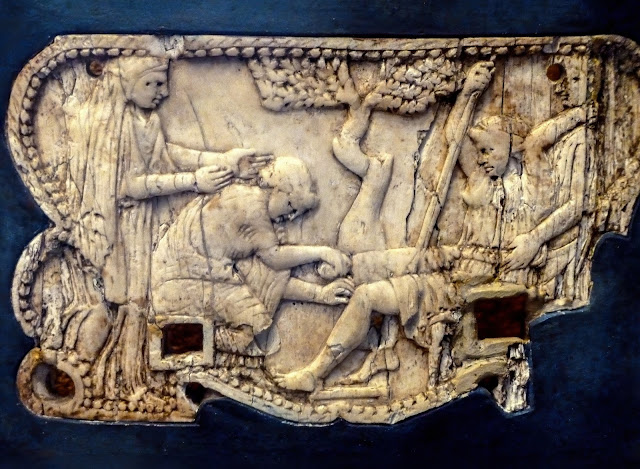
While working on Wikimedia Commons today, I saw this interesting 1st century CE ivory furniture applique from Pompeii depicting a Roman birthing scene. The quality of the carving is quite good but what caught my attention was its inclusion of a stylized tree of life. The tree of life is widespread in the world's religious and philosophical traditions. In ancient Iran dating back to approximately the early 2nd millennium BCE, tw o trees, Mashyа and Mashyane, were thought to be the ancestors of all living beings. In ancient Assyria, 2500 BCE-690 BCE, the sacred tree of life is depicted attended to by human or eagle-headed winged genies, or the King, and blessed or fertilized with bucket and cone. In ancient Urartu, 860-590 BCE, the tree of life was a religious symbol drawn on walls of fortresses and carved on the armor of warriors. In the Jewish Book of Proverbs, dating to approximately 450 BCE, the tree of life is associated with wisdom. "Wisdom is a tree of life to them...

ANCIENT ARTS OF CHINA: A 5000 YEAR LEGACY ongoing at the Bowers Museum in Santa Ana, California

Image
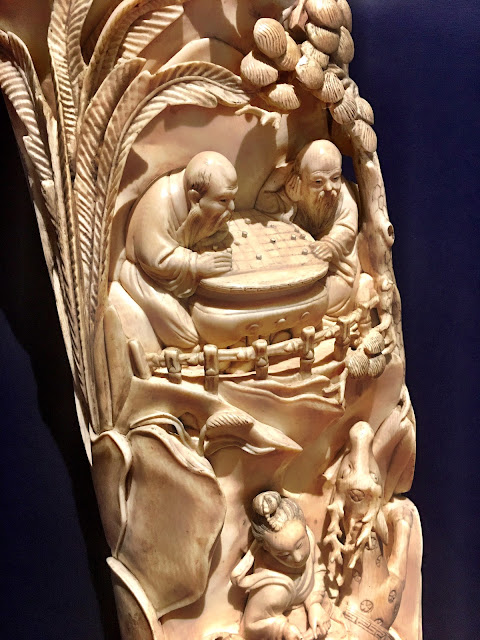
ANCIENT ARTS OF CHINA: A 5000 YEAR LEGACY ongoing at the Bowers Museum in Santa Ana, California. Journey back through 5000 years of Chinese history and follow the efflorescence of arts throughout one of the world's oldest living civilizations. From large painted ceramic pots used during the Neolithic period, to sculptures of camels and horses made at the height of the Silk Road, to beautiful embroidered silk court robes and ivory carvings from the 19th century, this exhibition presents the importance of fine art made to be admired during life and depended on in the afterlife. Image: Detail of a Carved Tusk, Qing Dynasty to Early Republic of China at the Bowers Museum in Santa Ana, California.  Image courtesy of the Bowers Museum.