Posts

Showing posts with the label grave goods

Red-figured fish plates of the 5th century BCE

Image
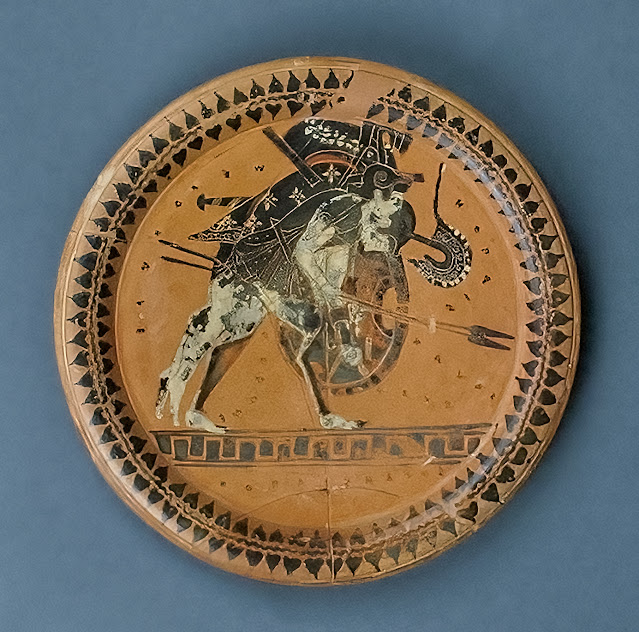
Throughout my travels to various museums around the world I have often encountered red-figured fish plates. First developed in Athens, these beautifully detailed serving pieces became especially popular in South Italy and Sicily in the 400s BCE. I stumbled across this excellent video about them and learned that fish plates produced in Magna Graecia were usually more colorful with white accents and the fish are portrayed with their bellies facing inwards towards the small central depression that is thought to have contained dipping sauce like garum. Fish on plates produced in Athens are painted with their bellies facing outwards. I thought this is quite a peculiar style difference.  There also seems to be disagreement among scholars as to whether these plates were actually used in everyday life or produced for funerary purposes only, as almost all of the 1,000 examples that have been recovered came from ancient burials. Art historian Lucas Livingston points out that many of the reco...

Mycenaean gold "seal" rings with Minoan-style iconography

Image
When the so-called "Griffin Warrior" was discovered near the Palace of Nestor in Pylos, the young man who died around 1500 BCE was buried with some 2,000 objects, including silver cups, beads made of precious stones, ivory combs, a sword and four intricately decorated solid gold rings. Archaeologists Shari Stocker and Jack Davis from the University of Cincinnati that excavated the warrior's burial think these grave goods provided evidence that Mycenaean culture recognized and appreciated Minoan culture more than previously believed, especially the gold rings. Made of multiple sheets of gold, the rings depict detailed scenes including bull leaping and iconography such as sun symbols and mythological genii creatures from Minoan mythology.   Originally the rings were thought to have probably been crafted on Crete where they were used to seal documents or indicate ownership of goods or other objects and pillaged in warfare. But, after extensive study, Stocker and Davis have e...

The psychological cost of warfare in the ancient world

Image
Then said Achilles, "Son of Atreus, king of men Agamemnon, see to these matters at some other season, when there is breathing time and when I am calmer. Would you have men eat while the bodies of those whom Hector son of Priam slew are still lying mangled upon the plain? Let the sons of the Achaeans, say I, fight fasting and without food, till we have avenged them; afterwards at the going down of the sun let them eat their fill. As for me, Patroclus is lying dead in my tent, all hacked and hewn, with his feet to the door, and his comrades are mourning round him. Therefore I can think of nothing but slaughter and blood and the rattle in the throat of the dying." - Iliad 19.226 As some of you know, I am the spouse of a veteran who has suffered from PTSD since service in Vietnam back in 1967-68. Although the psychological trauma suffered by those who have experienced a traumatic event now has a very modern-sounding diagnosis, it is not a recent phenomenon but has been a plague u...

A Celtic chieftain's grave

Image
The Hochdorf Chieftain's Grave is a richly-furnished Celtic burial chamber dating from 540 BCE near Hochdorf an der Enz (municipality of Eberdingen) in Baden-Württemberg, Germany. Beginning in 1968, a volunteer at the State Antiquities and Monuments Office in Baden-Württemberg, Renate Leibfried, kept coming across stone fragments plowed up in the field. She reported her observations and the Archaeological Preservation Office identified what had been a large burial mound.  Dr. Jörg Biel led a complete excavation of the site between 1978 to 1979. The grave contained a Celtic prince, roughly 40 years of age and 6 ft 2 in tall, who was laid out on a bronze recliner with eight wheels.  He wore a gold-plated torc on his neck, a bracelet on his right arm, a hat made of birch bark, a gold-plated dagger made of bronze and iron, rich clothing, amber jewelry and the remains of thin embossed gold plaques which once decorated his now-disintegrated shoes. Other grave goods included a razor ...

The Mycenaean Dendra Panoply

Image
In May 1960 Swedish archaeologists discovered the earliest example of a beaten bronze cuirass at Dendra, dated to the end of the fifteenth century BCE (Late Helladic IIIA - about 1400 BCE). It forms part of the Late Helladic Dendra Panoply, which consists of fifteen separate pieces of bronze sheet, held together with leather thongs, that encased the wearer from neck to knees.  The panoply was found in tomb 12 of the Dendra necropolis and had been partially plundered at some point.  But in addition to the squashed armor, archaeologists were able to recover pottery fragments, a silver toggle pin (probably used to fasten an item of clothing), a bronze oinochoe (jug), as well as various other objects of bronze, including at least one knife and a dagger, a bronze mirror, a gold-plated ring, fragments of a silver cup, fragments of boar's tusk and a pair of swords inlaid with gold and ivory. The panoply, when restored, was found to include a back and breast plate and six bronze plate...

The Greeks, From Agamemnon to Alexander the Great,” through September 15, 2019 at the Hangaram Museum in Seoul, South Korea

Image
“The Greeks, From Agamemnon to Alexander the Great,” through September 15, 2019 at the Hangaram Museum in Seoul, South Korea. This exhibit features 350 ancient Greek artifacts including funerary helmets with gold death masks from the mid-6th century BCE, votive sculpture, grave goods of 9th century BCE Macedonian aristocrats, gold serving ware and seal rings, ceramics featuring scenes from Homer's Odyssey, and a gold myrtle wre ath from a priestly warrior of Stavroupolis, companion to the king of 4th century BCE Macedon. I had the privilege of attending this marvelous exhibition when it was displayed at The Field Museum in Chicago, Illinois in 2016. I was astonished by the wealth of the grave goods on display and I particularly liked the way the grave goods were exhibited, placed in the position they were found in the burial chamber. Be sure to examine even the small items carefully, too. I was thrilled to see a small but beautifully carved Gorgon that was said to come from the b...