Posts

Showing posts with the label dragon

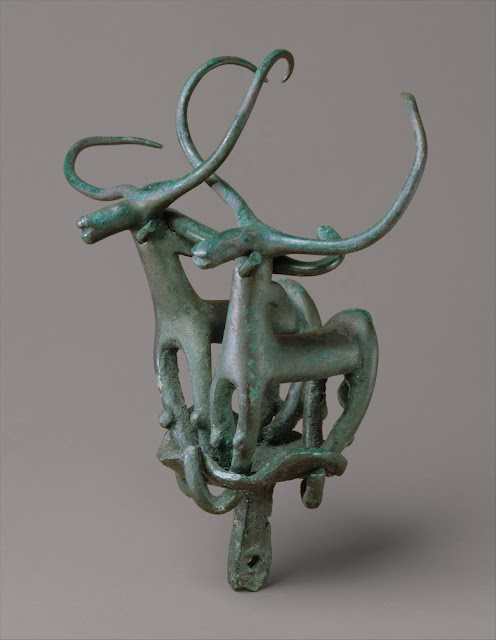
The Storm God of the Hatti then Hittite
Image
During the early Bronze Age the Hatti, who were neither Semitic nor Indo-European, inhabited central Anatolia. They were actually distinct from the Hittite but as the Hittite expanded beginning about 2000 BCE, the Hatti were gradually absorbed into the Hittite political and social order.  The Hatti were organized in monarchical city-states. These states were ruled as theocratic kingdoms or principalities. Hatti regions of Anatolia came to be influenced by mighty Mesopotamian polities, in the form the Akkadian Empire (24th-22nd century BCE) and the succeeding Old Assyrian Empire (21st-18th century BCE), both of which set up trading colonies called karum, located throughout eastern and central Anatolia. During the first centuries of the 2nd millennium BCE, an Assyrian trade colony existed in the city of Hattush, and several Assyrian inscriptions mention the existence of local rulers (kings) of Hattush, also referring to their relations with other city-states in the region. Fortunatel...

Sea monsters in ancient art

Image
The iconography of the Greek kētos (Latinized as cetus) was established in the Archaic period (ca. 600–480 BCE) and remained amazingly consistent for centuries, long into Roman Imperial times. It is one of the creatures that after the conquests of Alexander the Great (r. 331–323 BCE) traveled to the East, where it appeared in Gandharan art and influenced representations of monsters from Afghanistan to India. The kētos has even been suggested as a partial inspiration for the Chinese dragon. - Metropolitan Museum of Art According to Greek mythology, Perseus slew Cetus to save Andromeda from being sacrificed to it. In a different story, Heracles slew Cetus to save Hesione.The term cetacean (for marine mammals like whales or porpoises) was derived from cetus. In Greek art, ceti were depicted as serpentine fish, sometimes with the head of a greyhound and the body of a whale or dolphin with a divided fan-like tail.  In Greek translations of the Hebrew Bible, Jonah's "great fish...