Posts

Showing posts with the label Syria

The horse: A perfect gift to a Persian (or Parthian)

Image
"For a nomadic people like the Persians, the horse had a significant practical and symbolic purpose and the importance of horses among the Iranian nobility is evidenced by the fact that many of them bore names compounded with the Old Persian word aspa – ‘horse’, observes Lloyd Llewellyn-Jones, Senior Lecturer in Ancient History at the University of Edinburgh.  "Several of Darius I’s inscriptions note that Persia was a land containing both good men and good horses (DZe §1; DPd §2) and Herodotus famously states that Persian fathers were intent on teaching their sons ‘to ride, to draw the bow, and to speak the truth’ (1. 136; see also Strabo 15. 3.18). The premium Persian horses were bred in the alfalfa-rich plains of Media, and it was here that the main royal stud farms were located (Polybius 10.70). Most prized of all were those steeds bred on the plains of Nisaea near Ecbatana and Bisitun, and Nisaean horses became celebrated for their magnificence, fine proportions, and swif...

Wall mosaic with allegorical representation of Life and Easy Living, 350-400 CE from Emesa, Syria at the Royal Ontario Museum in Toronto, Canada

Image
In this detailed mosaic, an affluent couple is shown engaged in relaxed conversation on an elegant couch. The scene is given allegorical meaning by the Greek inscription, tryphe - bios, which identifies the female figure as Tryphe, meaning soft and leisurely living. The male figure is Bios, meaning Life. The allegory implies that life should be accompanied by pleasurable living. The man is also shown holding a magic wheel in his right hand. This was a charm used to keep lovers together - its presence further emphasizes the idea that Life and Easy Living should be inseparable. Image: Wall mosaic with allegorical representation of Life and Easy Living, 350-400 CE from Emesa, Syria at the Royal Ontario Museum in Toronto, Canada courtesy of the museum.

Age Old Cities: A Virtual Journey from Palmyra to Mosul through October 25, 2020 at the Freer/Sackler Galleries of Art in Washington D.C.

Image
Age Old Cities: A Virtual Journey from Palmyra to Mosul through October 25, 2020 at the Freer/Sackler Galleries of Art in Washington D.C. Ancient cultural sites in Palmyra, Aleppo and Mosul have been recreated virtually by the video game company Ubisoft, the company that recreated ancient Egypt and Greece in their Assassin's Creed game franchise. The recreations of such structures as The Temple of Baalshamin in Palmyra, the Great  Mosque of Al-Nuri, the souks of Aleppo, and the mausoleum of Nabi Yunnus can be experienced by visitors through multimedia displays and virtual reality devices. Visitors can watch interviews of those who witnessed the destruction of their cities and see first-hand the damage done to these UNESCO world heritage sites. A large map pinpoints exactly where the three featured cities are located then large-scale depictions of the destruction slowly morph into the full historic sites that once existed there. Ubisoft created the reconstructions by flying dron...

The Road to Palmyra through March 1, 2020 at the Ny Carlsberg Glyptotek in Copenhagen

Image
The Road to Palmyra through March 1, 2020 at the Ny Carlsberg Glyptotek in Copenhagen. Harald Ingholt, a Danish archaeologist, was on his third campaign of excavations at Palmyra, in present-day Syria, in 1928, when his team unearthed a half-length portrait of an unknown woman made between 190 and 210 CE in a tomb dubbed Qasr Abjad. The following year Ingholt presented The Beauty of Palmyra and around a dozen other sculptures  to Copenhagen’s Ny Carlsberg Glyptotek. Today, the Glyptotek’s collection of Palmyrene tomb sculptures is the largest outside Syria. For the past 18 months, Cecilie Brøns, an archaeologist and director of the Glyptotek’s Tracking Colour project, which examines the use of pigments in antiquity, has led a team reconstructing how the tomb sculpture may originally have looked. Using X-ray fluorescence, the team identified paint patches, mostly red and yellow ochre, which were well ­preserved due to the sculpture having been ­underground for nearly two millenn...

Ancient Art from the Palace of Ramesses III at the Boston Museum of Fine Arts in Boston, Massachusetts

Image
Ancient Art from the Palace of Ramesses III at the Boston Museum of Fine Arts in Boston, Massachusetts. Ramesses III was the last great military pharaoh of the New Kingdom. In his fifth year on the throne he defeated the Libyans and brought them back to Egypt as slaves. In his eighth year he faced an even greater threat: a confederation of displaced eastern Mediterranean tribes on the move, including Greeks and Philistines, known  collectively as the Sea Peoples. Fresh from their victory over the Hittites, the Sea Peoples attempted to invade Egypt with the intention of settling there. Ramesses roundly defeated them both by sea and by land, recording his victories on the walls of his mortuary temple at Medinet Habu, "United with Eternity," which remains the best-preserved royal mortuary temple on the west bank of Thebes. Images: Tiles depicting a Hittite chief, a Nubian Chief, and a Syrian Chief recovered from the Palace of Ramesses III at Medinet Habu, Egyp...

Closing soon! The World Between Empires: Art and Identity in the Ancient Middle East at the Metropolitan Museum of Art in New York through June 23, 2019

Image
Closing soon! The World Between Empires: Art and Identity in the Ancient Middle East at the Metropolitan Museum of Art in New York through June 23, 2019. For over three centuries, the territories and trading networks of the Middle East were contested between the Roman and Parthian Empires (ca. 100 B.C.–A.D. 250), yet across the region life was not defined by these two superpowers alone. Local cultural and religious traditions flo urished, and sculptures, wall paintings, jewelry, and other objects reveal how ancient identities were expressed through art. Featuring 190 works from museums in the Middle East, Europe, and the United States, this exhibition follows a journey along the great incense and silk routes that connected cities in southwestern Arabia, Nabataea, Judaea, Syria, and Mesopotamia, making the region a center of global trade. Image: Jointed alabaster statuette of a nude goddess with gold and ruby accents from Babylon in ancient Mesopotamia 1st century BCE - 1st...

"Syria Matters" through April 30, 2019 at Qatar’s Museum of Islamic Art (MIA) in Doha.

Image
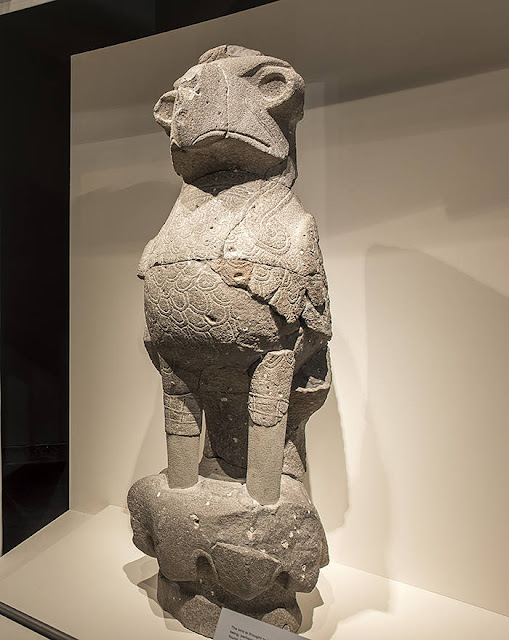
"Syria Matters" through April 30, 2019 at Qatar’s Museum of Islamic Art (MIA) in Doha. Basalt falcon, restored after a British air strike on a Berlin museum in 1943 © Chrysovalantis Lamprianidis/The Museum of Islamic Art, Doha Syria Matters is part of a year-long focus in Qatar on Syria and its contribution to world history. The exhibit includes a reproduction of a stone relief of the Hittite-period weather god from Aleppo (14th-13th-century BCE), and an 11th-century BCE king of “Palistin” with the originals appearing in situ on a screen. A limestone carving of a saddled camel recalls the leap from donkey to dromedary, around 1,000BCE, that expanded east-west trade networks through the desert city of Palmyra. Related website: https://www.ft.com/content/c733a884-f2fa-11e8-938a-543765795f99

Cultures in the Crossfire: Stories from Syria and Iraq, through November 25, 2018, The Pennsylvania Museum of Archaeology and Anthropology, Philadelphia, Pennsylvania

Image
Closing Sunday! Cultures in the Crossfire: Stories from Syria and Iraq, through November 25, 2018, The Pennsylvania Museum of Archaeology and Anthropology, Philadelphia, Pennsylvania Limestone loculus cover from Palmyra 2nd century CE photographed at the Penn Museum in Philadelphia, Pennsylvania. This new exhibition, created in conjunction with the Penn Cultural Heritage Center, sheds light on the ongoing destruction of cultural heritage in the Middle East by showing what’s at stake—the rich history of the region and the diversity of its people—and what’s being done to prevent the loss of this history and cultural identity. Fascinating ancient art and artifacts from the Penn Museum’s extensive Near East collection tell stories of the cultures of Syria and Iraq through time. Contemporary artwork from Issam Kourbaj, a Syrian artist based in Cambridge, UK, provides an art intervention—a modern-day response to the artifacts and themes. The exhibition features the important work ...