Posts

Showing posts with the label Hittite

The Storm God of the Hatti then Hittite
Image
During the early Bronze Age the Hatti, who were neither Semitic nor Indo-European, inhabited central Anatolia. They were actually distinct from the Hittite but as the Hittite expanded beginning about 2000 BCE, the Hatti were gradually absorbed into the Hittite political and social order.  The Hatti were organized in monarchical city-states. These states were ruled as theocratic kingdoms or principalities. Hatti regions of Anatolia came to be influenced by mighty Mesopotamian polities, in the form the Akkadian Empire (24th-22nd century BCE) and the succeeding Old Assyrian Empire (21st-18th century BCE), both of which set up trading colonies called karum, located throughout eastern and central Anatolia. During the first centuries of the 2nd millennium BCE, an Assyrian trade colony existed in the city of Hattush, and several Assyrian inscriptions mention the existence of local rulers (kings) of Hattush, also referring to their relations with other city-states in the region. Fortunatel...

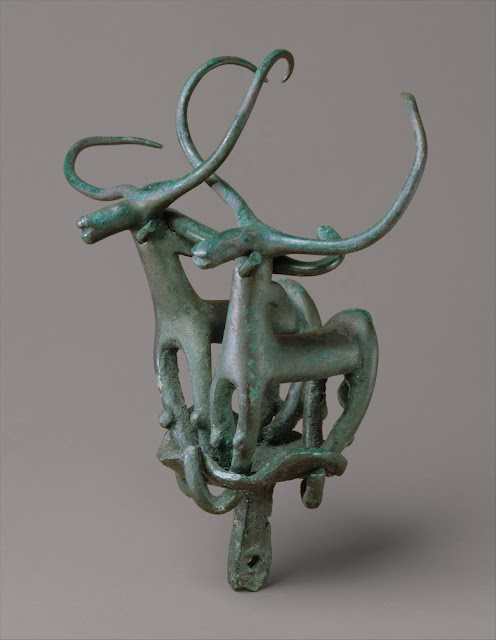
Stag vessel, Anatolia, Hittite Empire, 14th–13th century B.C.E. at the Metropolitan Museum of Art

Image
From Syria, Mesopotamia, and Egypt in the south to Thrace, Anatolia, and the Caucasus in the north, and from regions as far west as mainland Greece all the way east to Iran, the great royal houses forged intense international relationships through the exchange of traded raw materials and goods as well as letters and diplomatic gifts during the Second Millennium BCE. This unprecedented movement of precious materials, luxury goods, and people resulted in a total transformation of the visual arts throughout a vast territory that spanned the ancient Near East and the eastern Mediterranean.  Cult scenes or religious processions are commonly represented in the art of this period. Hittite texts mention that animal-shaped vessels made of gold, silver, stone, and wood, in the appropriate animal form, were given to the gods for their own use. One such god, worshiped in animal form, was the stag god.  It is thought that the ‘Stag God’ originated in the steppes and was brought to Anatolia...

Proto-Hittite Oxen and Cart

Image
I was researching information about some of the objects I photographed at the Dallas Museum of Art and came across a picture of this elegant Proto-Hittite oxen-drawn cart, 2000-1800 BCE.  When I first photographed the piece back in 2006 it was still quite corroded but I see the museum has since conserved it beautifully. Writing in a guide to the museum's collection, Anne Bromberg observes, "This bronze cart drawn by a pair of long-horned oxen is one of many examples of an artistic type well known from the early second millennium B.C.E. Such models were probably votive offerings, to be left in shrines, sacred caches, or tombs. They reflect the distinctive moment when men first used domesticated horses or cattle to draw wheeled vehicles, creating the beginning of powered transport on land. Although drawings of wheeled vehicles occur all over Eurasia, this seminal development in human culture probably originated in Mesopotamia or the Russian Steppes in the late third millennium B...

Chariots in ancient warfare

Image
 The origin of the chariot is not definitively documented but it is thought to have been a technology developed in the Eurasian steppe by cultures such as the Sintashta, a Middle Bronze Age civilization dating to the period 2200-1800 BCE.  The earliest remains of chariots have been found in Sintashta burials. Russian archaeological analysis indicates the preceding Abashevo culture was already marked by endemic intertribal warfare. Intensified by ecological stress and competition for resources in the Sintashta period, this drove the construction of fortifications on an unprecedented scale and innovations in military technique such as the invention of the war chariot.   Many Sintashta graves are furnished with weapons, although the composite bow associated later with chariotry does not appear. The Sintashta economy included the production of copper from ore in nearby mines  and arsenical bronze, that uses arsenic rather than tin, which was smelted on an industrial...

Now open, Meanwhile in the Mountains: Sagalassos at the Yapi Kredi Cultural Centre in Istanbul

Image
Now open, Meanwhile in the Mountains: Sagalassos at the Yapi Kredi Cultural Centre in Istanbul. A total of 368 original artefacts from the excavations of Sagalassos are now on display at the Yapi Kredi Cultural Centre in Istanbul, Turkey. From small terracotta sculptures to monumental statues of Marcus Aurelius and Hadrian, the exhibit explores how people lived, worked, ate, and dealt with death. About 100 km north of moder n Antalya, the city is referenced in early Hittite documents naming a mountain site of Salawassa in the fourteenth century BCE. The town grew during the Phrygian and Lydian cultures. Sagalassos was one of the wealthiest cities in Pisidia when Alexander the Great conquered it in 333 BCE on his way to Persia. After Alexander's death, the region became part of the territories of Antigonus Monophthalmus, then possibly Lysimachus of Thrace, the Seleucids of Syria and finally the Attalids of Pergamon. In 39 BCE, the region of Pisidia was ruled by the Roman clie...

Ancient Art from the Palace of Ramesses III at the Boston Museum of Fine Arts in Boston, Massachusetts

Image
Ancient Art from the Palace of Ramesses III at the Boston Museum of Fine Arts in Boston, Massachusetts. Ramesses III was the last great military pharaoh of the New Kingdom. In his fifth year on the throne he defeated the Libyans and brought them back to Egypt as slaves. In his eighth year he faced an even greater threat: a confederation of displaced eastern Mediterranean tribes on the move, including Greeks and Philistines, known  collectively as the Sea Peoples. Fresh from their victory over the Hittites, the Sea Peoples attempted to invade Egypt with the intention of settling there. Ramesses roundly defeated them both by sea and by land, recording his victories on the walls of his mortuary temple at Medinet Habu, "United with Eternity," which remains the best-preserved royal mortuary temple on the west bank of Thebes. Images: Tiles depicting a Hittite chief, a Nubian Chief, and a Syrian Chief recovered from the Palace of Ramesses III at Medinet Habu, Egyp...

Forgotten Kingdoms: From the Hittite Empire to the Arameans through August 12, 2019 at The Louvre in Paris, France

Image
Forgotten Kingdoms: From the Hittite Empire to the Arameans through August 12, 2019 at The Louvre in Paris, France. The Hittite empire, a great rival power of ancient Egypt, ruled over Anatolia and held sway over the Levant until about 1200 BC. Its demise gave rise to Neo-Hittite and Aramean kingdoms in modern-day Turkey and Syria, heirs of the political, cultural, and artistic traditions of the fallen empire. The exhibition inv ites visitors to rediscover the mythic sites of this forgotten civilization, such as the majestic remains of the Tell Halaf site, located near the current Turco-Syrian border. This major Syrian heritage site was discovered by Max von Oppenheim, who conducted excavations there from 1911 to 1913. The large sculptures, which adorned the palace of the Aramean king Kapara, were brought back to Berlin where they were exhibited, then very heavily damaged in WW2 bombings. An incredible conservation project carried out in the early 2000s made it possible to rehabili...

Roman-era mosaics in the Adana Archaeology Museum in Adana, Turkey

Image
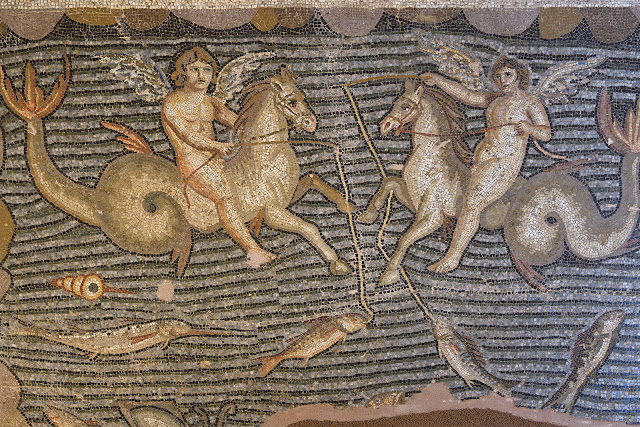
Roman-era mosaics in the Adana Archaeology Museum in Adana, Turkey.  Newly opened galleries at the Adana Museum now house an astonishing collection of Roman-era mosaics.  The mosaics depict an array of themes from classical mythology including Orpheus, Thetys, Artemis, and Erotes, as well as early Christian portrayals of the "Peaceful Kingdom" and Noah's Ark.  The museum has constructed elevated walkways in the new gallery space so visitors can view the expansive mosaics, many that once adorned church floors, more easily. The museum also has many objects from the Hittite period as well as artifacts from the Neolithic, Bronze Age, Iron Age, Archaic, Roman, Byzantine, and Ottoman eras.  Roman objects include sarcophagi, jugs, catapult shots, inscriptions, architectural elements, glassware, ceramics and jewellery. All images cc by courtesy of Dick Osseman:

Assyrian, Hittite and Phyrgian art. Ongoing. At the Kayseri Archaeological Museum in Kayseri, Turkey.

Image
Assyrian, Hittite and Phyrgian art. Ongoing. At the Kayseri Archaeological Museum in Kayseri, Turkey. Ceremonial jar in the shape of a Bull 1800 BCE Roman sarcophagus depicting the adventures of Heracles 2nd-3rd century CE Neo-Hittite Portal Lions 8th century BCE The archaeological site of Kültepe is just 14 miles southwest of Kayseri and so much of the archaeological museum's space is dedicated to artifacts recovered from the site. Kaneš, the ancient city at the heart of the Kültepe archaeological site, was inhabited continuously from the Chalcolithic to Roman times and flourished as  an important Hattian, Hittite and Hurrian city, containing a large kārum (merchant colony) of the Old Assyrian Empire from the 21st to 18th centuries BCE. Over 20,000 cuneiform tablets were recovered from the site and many of these as well as pitchers, vases, stamps, bowls, metalware and reliefs are displayed in the first hall of the museum. Phrygian ceramics are displayed in the...